


Amazon’s sprawling global logistics footprint is one of the world’s most complex and powerful supply chain networks. Understanding the Amazon number of warehouses in 2025 and the number of employees working inside these facilities is essential.
The ongoing evolution of this logistics network is a critical data point for journalists and bloggers. These figures help illustrate Amazon’s delivery capacity, labor scale, automation strategy, and global operational reach.
This data helps illuminate Amazon’s delivery capabilities, labor force, automation strategy, and global presence.
Key Statistics at a Glance
- Total global logistics facilities: 1,200
- Fulfillment centers globally: 350
- Amazon warehouses in the USA: 600
- Amazon warehouses in India: 100+
- Global employees: 1.56 million
- Average workers per warehouse: 670
- Amazon warehouse jobs added in 2025: 250,000
- Employees retrained for robotics/technical roles: 700,000
- Robots in warehouses globally: 1,000,000
- Percentage of deliveries assisted by robots: 75%
- DeepFleet AI efficiency gain: 10%
- Warehouse docks in large fulfillment centers: 55 docks.
- Micro-fulfillment / urban delivery facilities (U.S.): 250
- Last-mile delivery cost share: Up to 53% of total shipping cost
- Packages per day in micro-fulfillment centers: 10,000
- Micro-fulfillment center size: 30,000–80,000 sq ft
- Micro-fulfillment center staff: 80–120 workers
- Picking efficiency with compact automation: 20–30%
- Demand for small industrial units in major U.S. cities: +25% growth (2020–2024)
- Daily package deliveries in New York: 2.4 million
Number of Amazon Warehouses by Region
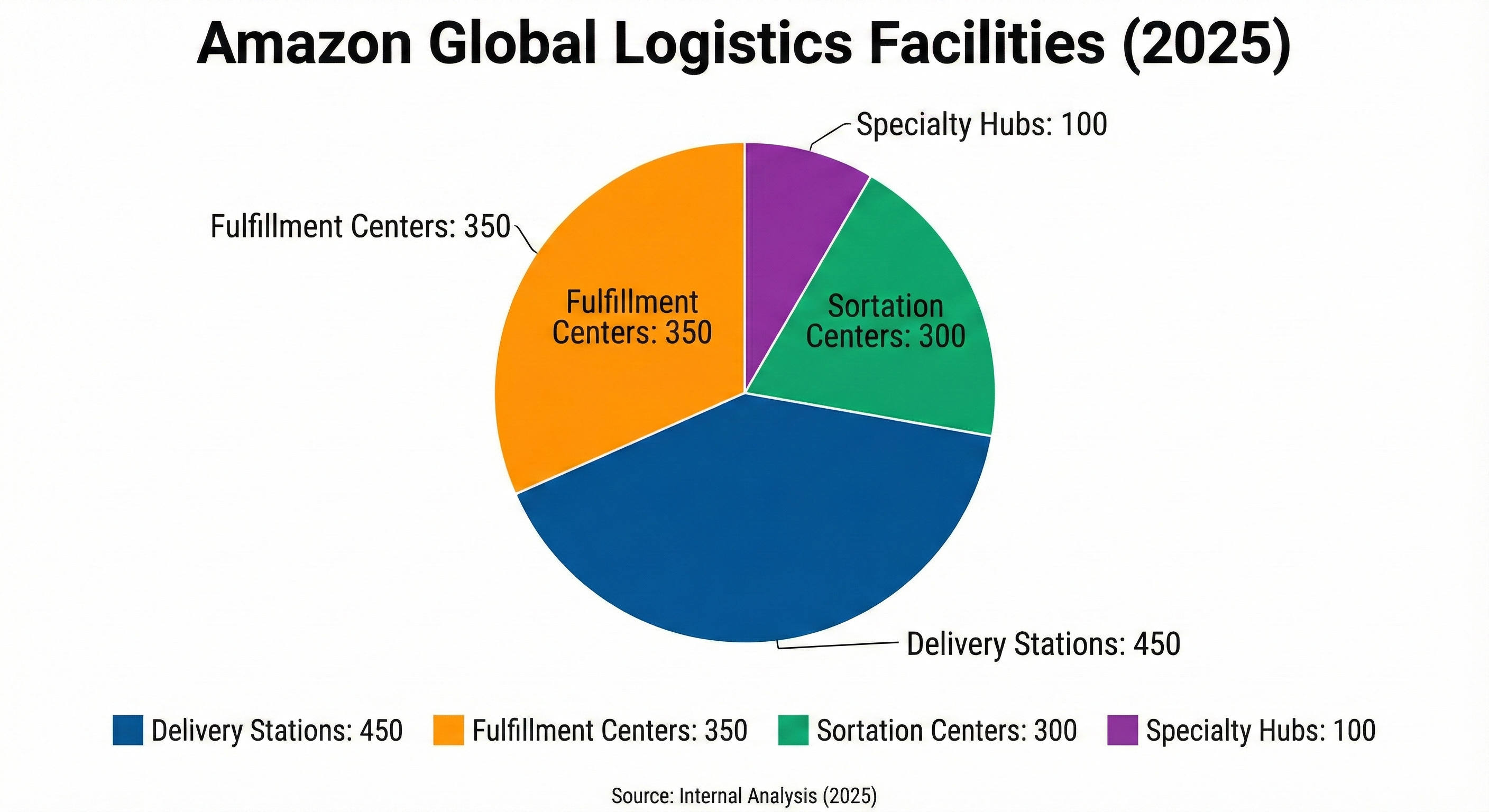
When we talk about the number of Amazon warehouses worldwide, it is important to clarify what “warehouses” means: Amazon’s logistics facilities include not just large fulfillment centers, but also sortation centers, delivery stations, and specialized hubs.
According to recent data, Amazon operated about 1,200 such logistics facilities in 2025.
Within that broader network, fulfillment centers (FCs) number somewhere around 350 globally, based on analyses that distinguish large pick‑pack‑ship facilities from smaller delivery or sorting sites.
Number of Amazon Warehouses in the U.S.
Focusing on the number of Amazon warehouses in the USA, recent counts suggest Amazon runs over 600 active logistics sites in the U.S., spanning fulfillment centers, sortation facilities, and delivery stations.
Some of the states leading in logistics presence include California (35 fulfillment centers), Texas (28 fulfillment centers), and New Jersey (17 fulfillment centers), which host some of the largest fulfillment centers by square footage.
Red Stag Fulfillment
These U.S.-based facilities are critical to Amazon’s domestic operations and allow it to deliver quickly to a large proportion of American customers.
Source: Red Stag Fulfillment
Amazon Warehouse Network in India and Other Key Countries
Internationally, Amazon’s warehouse footprint is also growing aggressively. Amazon does not always publicly break down the number of Amazon warehouses in India.
The company has significantly expanded its logistics network across India in recent years, adding large FCs, sortation centers, and delivery stations to serve the subcontinent’s growing e-commerce demand.
Similarly, Amazon operates large warehouse networks across Europe, Asia, and other regions, contributing to its total number of warehouses worldwide. For example, in Europe, Amazon maintains a mix of fulfillment centers and regional hubs to serve multiple EU markets efficiently.
Amazon Warehouse Workforce
One of the most important metrics is the Amazon warehouse number of employees. Globally, Amazon employs about 1.56 million people, many of whom are warehouse workers.
Due to rapid automation, the average number of workers per Amazon warehouse (counting major fulfillment centers) has declined in recent years, reported to be roughly 670 employees per facility. (edwardconard.com)
This drop in headcount per facility reflects Amazon’s increasing reliance on machines, but also points to higher productivity per worker. For instance, the number of Amazon warehouse jobs added in 2025 is 250,000, but Amazon also reports retraining over 700,000 employees for more technical or supervisory positions tied to robotics.
Sources: allwork.space, Edwardconard, Geekwire
Amazon’s Robot Army: Number of Robots in Warehouses
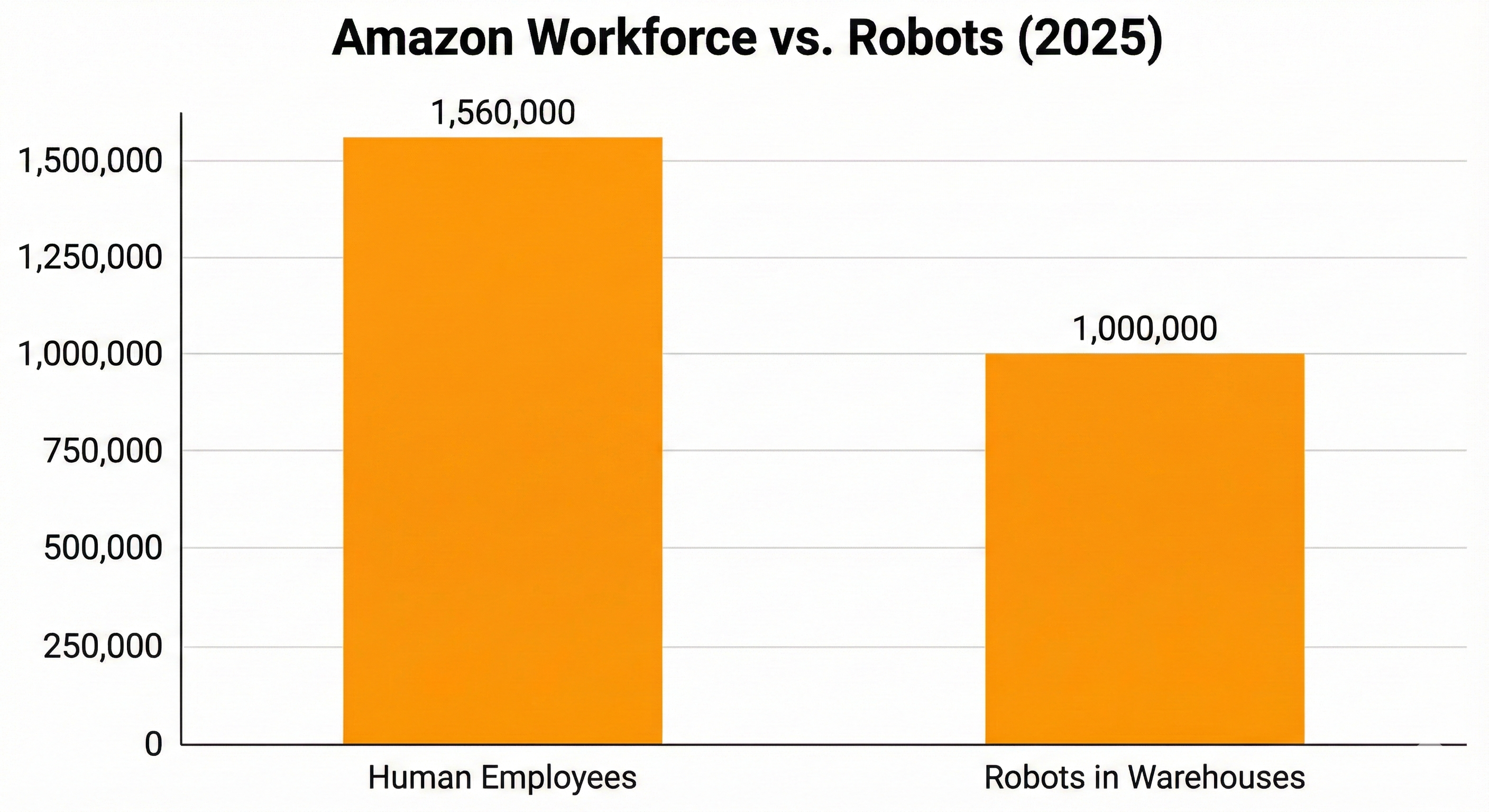
A major shift in Amazon’s logistics model is the dramatic rise in robotics. The Amazon number of robots in warehouses 2025 has crossed the 1 million mark.
Robots now play a role in about 75% of Amazon’s global delivery volume, assisting with sorting, picking, and transporting inventory across the warehouse network.
These robots, from wheeled mobile robots like Proteus to arms like Vulcan, are coordinated by Amazon’s internal AI system, DeepFleet, which improves efficiency by roughly 10% over earlier generations.
This surge in automation is not just about replacing humans. Amazon says it augments its workforce, allowing employees to shift into higher-value roles, including maintenance, robotics oversight, and flow control.
Micro Fulfillment and Urban Warehousing
The expansion of micro-fulfillment centers and urban warehouses shows a major shift in Amazon’s logistics strategy. The high-speed facilities become critical to Amazon’s last-mile delivery model, as industry data shows a strong rise in smaller urban nodes.
By 2025, Amazon is estimated to operate more than 250 micro-fulfillment or urban delivery facilities across the United States, with similar growth in Europe and Asia.
These sites complement the wider network of about 1,200 global logistics facilities, but they serve a distinct purpose: reducing delivery time and lowering the high cost of last-mile operations.
Why Micro Fulfillment Matters for Last Mile Delivery
According to the logistics studies, last-mile delivery accounts for up to 53 percent of total shipping cost. On the other hand, Amazon shortens routes, reduces the transportation expenses, and supports one-day or even one-hour delivery windows for its consumers.
In cities like New York, Los Angeles, London, and Berlin, Amazon’s micro-fulfillment centers can handle between 10,000 and 20,000 packages per day, depending on staffing and inventory load.
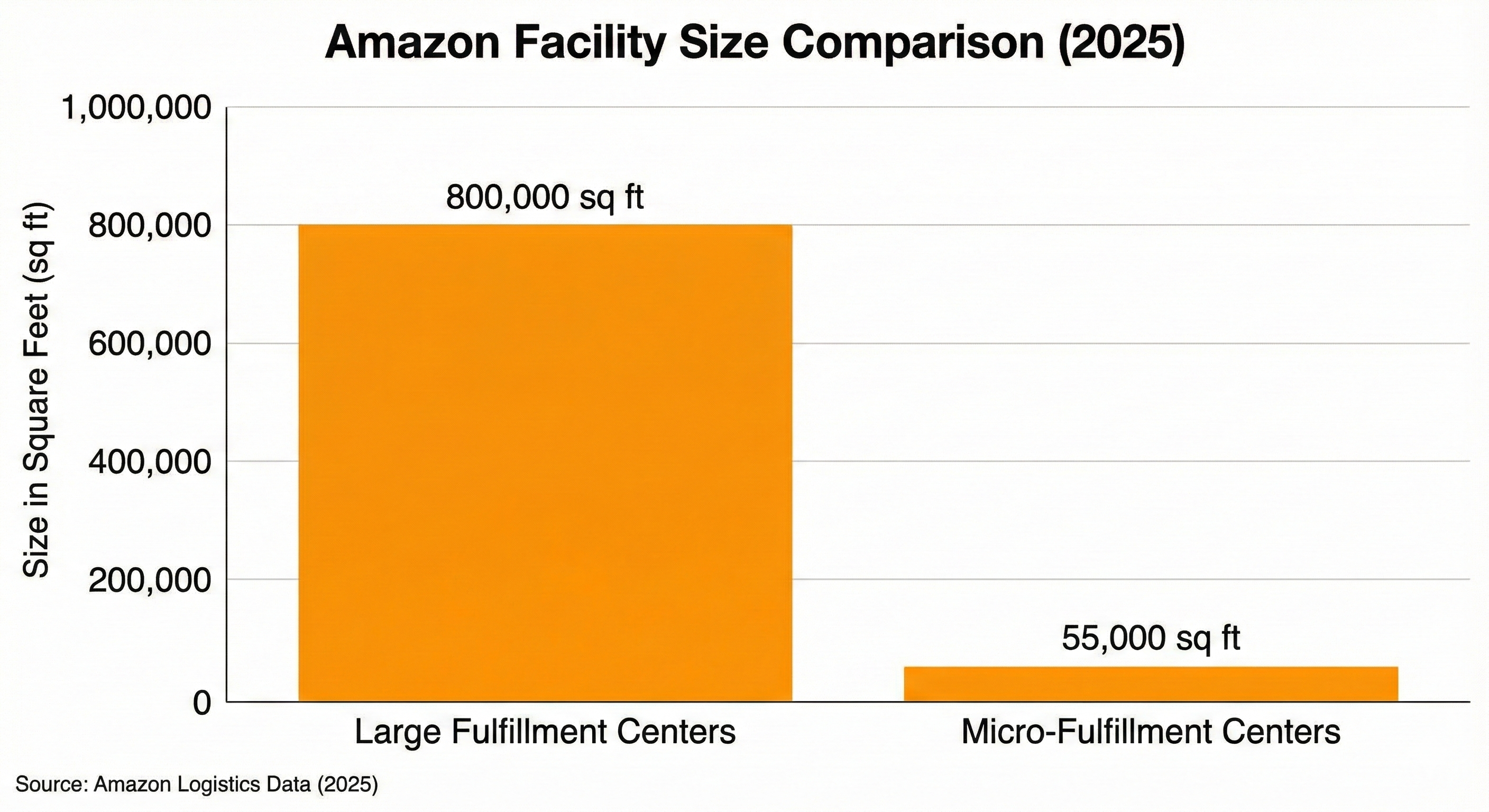
These facilities are much smaller than traditional fulfillment centers, usually measuring 30,000 to 80,000 square feet, compared with the 800,000 square feet footprint common for large fulfillment hubs.
The high-demand products are stored in a way that allows them to move quickly, enabling swift packing and shipping processes that help maintain delivery speed.
Workforce Structure Inside Micro Fulfillment Centers
These micro-sites also change Amazon’s workforce structure. A typical micro-fulfillment center employs between 80 and 120 workers, far fewer than the average 670 employees found in traditional fulfillment centers.
Yet the jobs inside these sites are often more specialized, involving rapid order picking, local dispatching, and courier coordination. Some locations use compact automation systems that speed up picking by 20 to 30 percent even in tight warehouse spaces.
Effects on Urban Real Estate and City Logistics
Rapid growth in urban warehousing also affects city real estate markets. Demand for small industrial units in major U.S. cities grew more than 25 percent from 2020 to 2024, driven heavily by Amazon’s expansion.
Urban regions are now seeing more delivery vans and cargo bikes, especially in dense cities like New York, which handles more than 2.4 million package deliveries per day. As Amazon brings warehousing deeper into city centers, it is reshaping delivery patterns, local economies, and real estate landscapes.
Conclusion
Amazon’s warehouse network is not just large; it is evolving at a staggering pace. Thanks to automation and robotics, the number of Amazon warehouses in the USA and worldwide is being matched by a next-generation workforce of machines.
Meanwhile, the Amazon warehouse number of employees remains substantial, but their roles are shifting, from manual pickers and dock workers to robotics technicians and flow managers.