

by Muhammad Rahat
August 31, 2026

Reviewed by Ford
Truck Dispatch Specialist
CSA violations have a major impact on a carrier’s profile. The violations also affect a driver’s PSP report. Violations have different impacts on a carrier or a driver’s record.
Violations with high severity weights quickly increase a carrier’s BASIC scores. This increases insurance premiums and decreases job opportunities. High scores may contribute to enforcement actions.
In this guide, you will learn about the violations with the highest severity weights. You will understand how they receive the severity weights and how you can avoid them. You will learn how violations and BASIC scores affect carriers or drivers in the short and long term.
- What Are CSA Violation Points?
- How the FMCSA Calculates CSA Scores
- CSA Violation Points List by BASIC Category
- Common CSA Violations and Their Severity Weights
- Highest CSA Violation Points You Should Avoid
- How Long Do CSA Violations Stay on Your Record?
- How CSA Violations Affect Drivers and Carriers
- Improve Fleet Safety and Compliance with Max Dispatch
What Are CSA Violation Points?
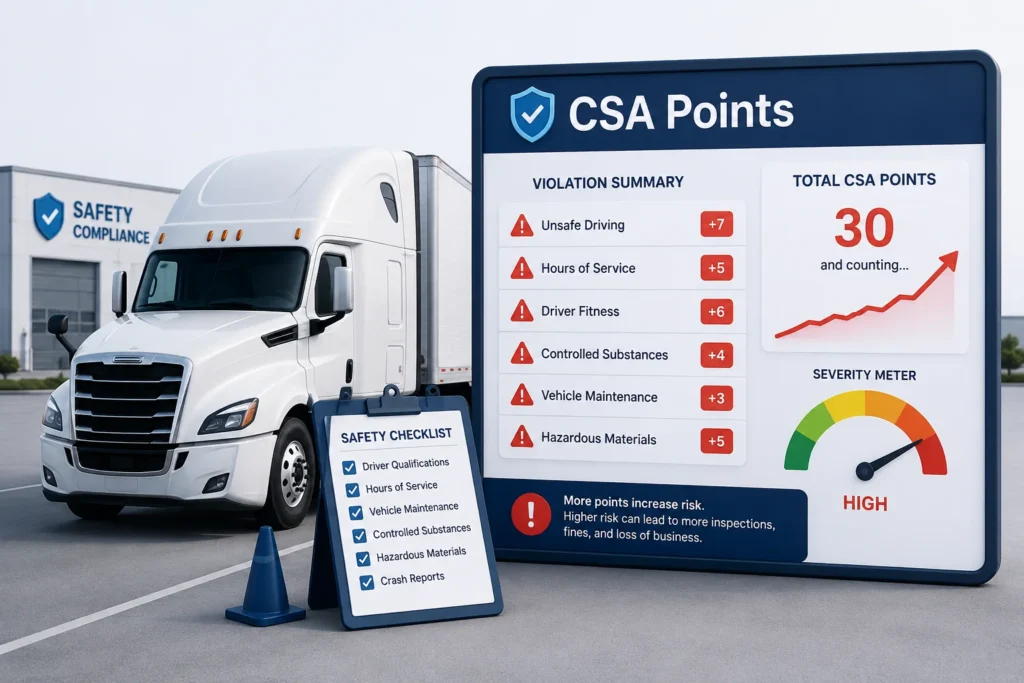
CSA violation points are numerical values from 1 to 10. These points are used to assess the safety of a driver or a motor carrier. The FMCSA assigns CSA violation points under its Compliance, Safety, Accountability program.
How CSA severity weights work
CSA severity weights are values relative to crash risk. Each violation within a BASIC (Behavior Analysis and Safety Improvement Category) is assigned a weight from 1 to 10. A weight of 1 represents the lowest crash risk, while 10 represents the highest. For the out-of-service order violation, FMCSA adds an extra weight of 2. This is not the overall score. CSA severity weights are used to calculate the BASIC measure and percentile ranking.
Are CSA violation points the same as CSA scores?
CSA violation points are the numerical values assigned to each violation. They describe the risk severity for each violation. CSA score is the broad safety measure of a motor carrier. CSA violation points are one part of the Safety Measurement System. For the BASIC measure, SMS weights violations by time and severity. When sufficient data is available, a percentile is calculated. So, a violation is a single input, and a CSA score is used in a BASIC measure to check safety.
How severity weights affect carriers and drivers
A high severity weight of a carrier increases the Safety Measurement System percentile. It causes a warning letter and targeted intervention. Insurance companies drop coverage for carriers with high BASIC scores. It also affects contracts with shippers.
Violations stay on drivers’ records for 3 years. High-severity weight affects a driver’s PSP report. Employers review drivers’ safety records. Violations also risk their job opportunities. Repeated high-severity offenses immediately lead to out-of-service orders.
How the FMCSA Calculates CSA Scores
To calculate the CSA score, the FMCSA collects safety records on the driver or motor carrier. That data includes roadside inspections, crashes, and applicable investigation data from the last 24 months. Then each violation receives a severity weight and a time multiplier. The BASIC measure is adjusted using applicable exposure factors. Exposure factors include carrier size, miles traveled, and number of trucks.
Severity weights
The FMCSA assigns each safety violation a severity weight. That weight describes the chances of a crash and its consequences. For example, in an hours-of-service violation, the severity weight is as follows:
- 10 Points: Driving while ill or fatigued, or falsifying a logbook.
- 7 Points: Exceeding the 11-hour driving limit or the 14-hour on-duty limit.
- 1 to 5 Points: Missing a logbook entry, form/manner errors, or failing to submit logs on time.
Each severity weight is multiplied by the applicable time weight. The result contributes to the BASIC. It’s not the final CSA score.
Time weighting of violations
Time weighting of violations means a more recent violation has a greater impact. The violation weight is multiplied by a specific number according to the time of occurrence. Time multipliers are added as follows:
- 0 to 6 Months Ago: Multiplied by 3 (Highest impact on the score)
- 6 to 12 Months Ago: Multiplied by 2 (Moderate impact)
- 12 to 24 Months Ago: Multiplied by 1 (Lowest impact)
- After 24 Months: Drops off the carrier’s profile completely and no longer impacts the score.
There is an exception in the time-weight rule. For motor carriers, the timeline is 24 months. The timeline is longer for a driver. A crash record remains for 5 years on a driver’s PSP report. The roadside inspection stays for 3 years.
Inspection type and violation impact
Roadside inspections directly affect the CSA scores. There are three most common types of inspection. If a violation falls outside the scope of an inspection level, it will not hurt the CSA score. The three inspection levels are given below:
- Level I (North American Standard): driver and entire vehicle inspection
- Level II (Walk-Around Driver/Vehicle): a level 1 inspection in which the inspector cannot get under the vehicle to check components
- Level III (Driver/Credential/Administrative): driver and paperwork inspection
In the first two levels of inspection, vehicle-related violations can increase CSA scores. In a Level III inspection, vehicle components are not inspected. Every roadside inspection checks the driver’s credentials and hours-of-service log. So, in all three levels, drivers’ reports are at risk.
CSA Violation Points List by BASIC Category
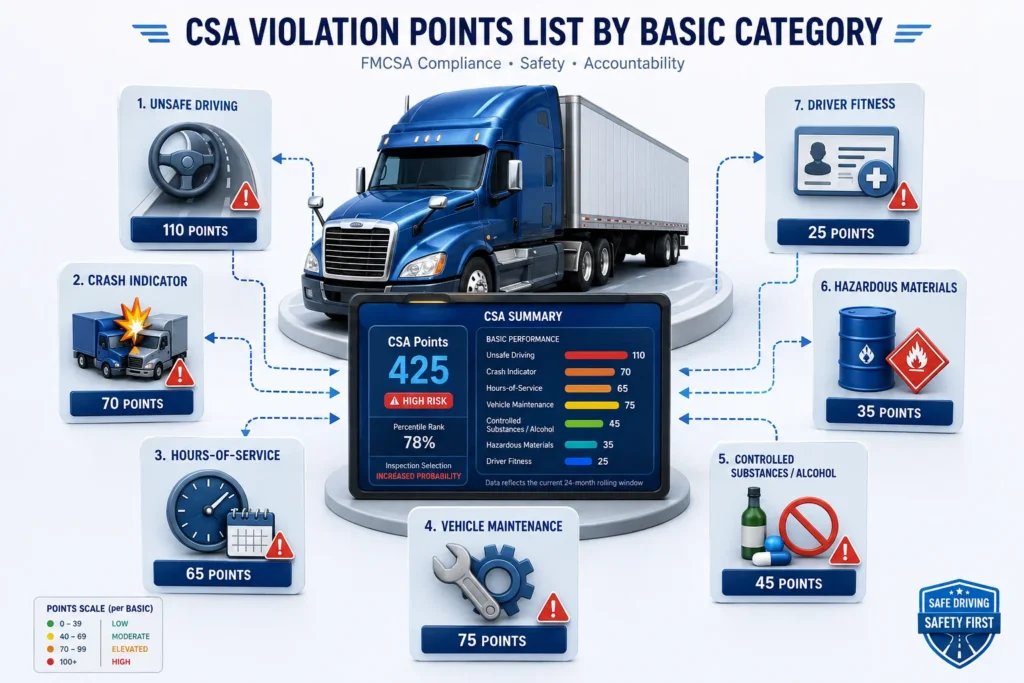
The violations are organized into seven different categories called BASIC within SMS. BASIC stands for Behaviour Analysis and Safety Improvement Category. Each category focuses on a different area of motor carrier safety performance.
Unsafe Driving violations and severity weights
Unsafe Driving BASIC covers driving behaviour. Severity weights are assigned depending on the violation and risk of crash. Severity weights and their violations are as follows:
- 10 points: Reckless driving; Speeding 15+ MPH over limit; Speeding in construction/work zone; Texting while driving; Hand-held mobile phone use
- 7 points: Speeding 11–14 MPH over limit; Seat belt violation
- 5 points: Following too closely; Improper lane change; Improper passing; Traffic control device violation; Failure to maintain lane; Improper turn; Failure to yield; Distracted driving; Railroad crossing violation; Impeding traffic
- 3 points: Lane restriction violation; Failure to dim headlights
- 1 point: Speeding 1–5 MPH over limit; Unlawful parking; Failure to activate hazard flashers
Hours of Service (HOS) violations and severity weights
This category does not have a standalone 10-point severity. The FMCSA assigns a weight of 7 (the maximum severity weight) to HOS violations within the SMS. However, it can get an extra penalty and time weights. Examples are:
- 7 points: Driving >11 hours; Driving beyond 14-hour window; Driving beyond 60/70-hour limit; False RODS; False duty-status report; Improper Personal Conveyance
- 5 points: Failure to maintain RODS; ELD unassigned driving time; ELD display/information violations
- 1 point: ELD form-and-manner violations; Failure to certify ELD records; Missing manual entries; Missing ELD instructions; Blank RODS graph-grid
Vehicle Maintenance violations and severity weights
This category includes vehicle inspection, repair, and maintenance. Vehicle maintenance BASIC is examined very closely. It may be the direct cause of a crash. The severity weights and their violations are given below:
- 8 points: Tire flat/audible air leak; Tire inflation below 50%; Tire sidewall/ply damage; Tire tread violations
- 7 points: Missing/not engaged locking pins; Deflated air suspension
- 6 points: Inoperative turn signals; Inoperative stop lamps; Inoperative headlamps
- 4 points: Brake adjustment violations; Air brake leaks; Damaged brake hoses/tubing; ABS malfunction; Defective brake components
- 3 points: Oil/grease leaks; Improper reflectors; Unprotected battery
- 2 points: Inoperative required lamps; Inoperative identification lamps; Missing/discharged fire extinguisher; Inspection/repair/maintenance violations
- 1 point: Missing/defective mud flaps; Inoperative wipers; Improper fuel filler cap; Improper cargo securement
Driver Fitness violations and severity weights
Driver Fitness BASIC ensures that the driver is medically qualified and physically fit to drive a commercial vehicle. Its severity points are listed below:
- 8 points: Operating without valid CDL; Operating while disqualified; CDL suspension for safety-related reason; CDL restriction violation
- 5 points: CDL suspension for safety-related reason in another state; CDL suspension for non-safety-related reason; Disqualification for non-safety-related reason
- 2 points: Medical qualification violation; Medical certificate violation; Corrective lens violation; Hearing aid violation
- 1 point: CDL suspension for non-safety-related reason in another state; Disqualification for non-safety-related reason in another state
Controlled Substances & Alcohol violations and severity weights
This category checks drug and alcohol testing. This BASIC addresses whether the driver possesses an intoxicating substance. Controlled substances and alcohol violations and their severity weights are as follows:
- 10 points: Drug possession; Drug use/under the influence; Controlled-substance impairment
- 5 points: Alcohol use/under the influence; Detectable alcohol while on duty; Alcohol-related CMV operation
- 3 points: Alcohol possession while on duty; Alcohol possession in CMV
Hazardous Materials (HM) violations and severity weights
Hazardous materials require safe transport. Any violation of this BASIC can seriously impact CSA scores. Compliance with the Hazardous Materials BASIC involves proper packing, marking, labeling, and loading of cargo. Violations can lead to the following severity weights:
- 10 points: Prohibited hazardous materials on passenger vehicle; Serious HM load-securement violations
- 8 points: Improper HM packaging; Package specification violations; Package integrity violations; Defective cargo-tank safety components
- 7 points: Failure to test/inspect damaged specification cargo tank
- 5 points: Improper HM markings; Missing/incorrect placards; Missing radioactive markings; Fumigated-load marking violations
- 4 points: Failure to provide exclusive-use instructions; HM cargo protection violations
- 3 points: Improper shipping papers; Missing emergency-response information; Improper HM documentation; LPG marking/documentation violations
- 2 points: Failure to comply with FMCSR requirements while transporting HM; CDL provisions while transporting HM
Crash Indicator BASIC (how crashes are measured)
Crash indicator BASIC evaluates the carrier accident history. Roadside inspection alone does not determine the severity weight. Instead, the crash indicator measure is determined using mathematical calculations. First, the base score is assigned as follows:
- 2 points: Crash involving injury or fatality
- 1 point: Tow-away crash with no injury or fatality
- Additional severity consideration: Hazardous-material release
- Excluded: Crash determined “Not Preventable” through FMCSA’s Crash Preventability Determination Program
To calculate the crash indicator, multiply the base score by the time factor. After that, time-weighted crash points are divided by the carrier’s average power units. This step normalizes the crash rate. Final percentile rank is calculated by comparing similar carriers with the same number of operations.
Common CSA Violations and Their Severity Weights
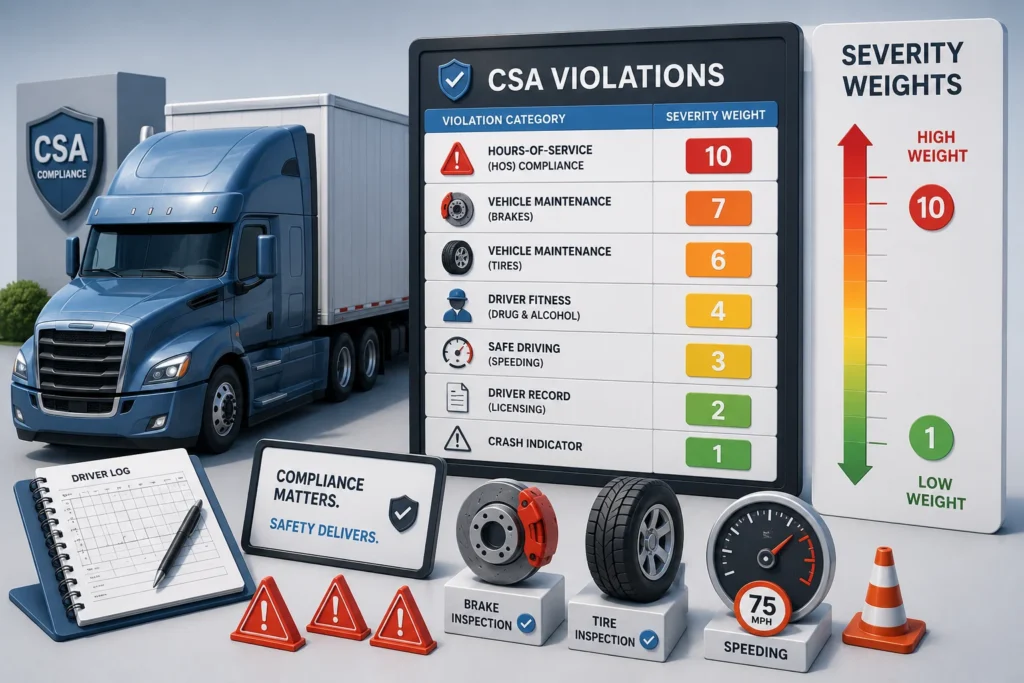
Out of all the violations, some are quite common. These common violations have high severity weights and a significant impact on CSA scores. Common violations are discussed in detail below.
Speeding violations
Speeding violations fall under unsafe driving BASIC. These violations carry the highest risk of crashes. Speeding violations get maximum penalties due to high risk. Severity weights of these violations are as follows:
- 10 points: Speeding 15+ MPH over the limit
- 7 points: Speeding 11–14 MPH over the limit
- 4 points: Speeding 6–10 MPH over the limit
- 1 point: Speeding with unspecified MPH over the limit
- 0 points: Speeding 1–5 MPH over the limit
Seat belt violations
This is another common example of an unsafe driving BASIC violation. Not wearing a seat belt while driving increases the risk of injuries. It spikes the CSA scores. A seat belt violation has severity points of 7, and the applicable time weight also applies. This type of violation immediately impacts the carrier profile.
Handheld mobile phone and texting violations
These violations are tracked under the unsafe driving category. The FMCSA considers distracted driving an extremely serious safety hazard. So, the FMCSA assigns 10 severity points to both of these violations. Holding a phone for voice communication, dialing a number, and reaching for a phone are considered violations. Drivers can face heavy fines due to these violations. They may be disqualified for a specific time.
Hours of Service violations
When a driver exceeds the permitted driving hours, it results in hours-of-service violations. Their severity weights for these violations are listed above. Drivers should use applicable HOS exceptions when they meet the requirements. Short-haul drivers can benefit from it. Extreme weather conditions also provide extra service hours.
Vehicle inspection and brake violations
Vehicle inspection and brake violations carry the highest severity weights. This is because they carry the highest risk of accidents. These violations have the following severity weights:
- 4 points: Failure to conduct pre trip inspection; Brake out of adjustment; Defective brake components; ABS malfunction; Automatic slack adjuster malfunction
- 2 points: Failure to inspect emergency equipment; Defective emergency equipment
- 1 point: Vehicle inspection violation; Required equipment defect; Minor brake defect
Certain violations in this category can also trigger an out-of-service order. If a vehicle has 20% or more of its brakes out of adjustment or with defective components, the vehicle may be placed out of service. Inspectors compare the pre-trip inspection document with the current vehicle condition. A mismatch can cause a failure-to-inspect violation.
Tire and lighting violations
Tire and lighting violations are among the leading causes of crashes. So they get the high severity weights. Damaged tires and missing lights can cause out-of-service violations. The severity weights of tire and lighting violations are given below:
- 8 points: Tire flat; Tire inflation below 50%; Tire leakage; Tire tread violation
- 6 points: Inoperative stop lamps; Required lighting defect
- 4 points: Inoperative headlamps; Inoperative turn signals
- 2 points: Inoperative identification lamps; Minor lighting defect
- 1 point: Defective mud flaps; Minor reflector defect
Load securement violations
Inspectors carefully look for load securement, as violations can cause highway accidents. They count the tie-downs relative to cargo weight and height. Inspectors ensure that the working load limit of the tie-downs does not exceed 50% of the cargo weight. Severity weights for these violations are:
- 7 points: Cargo leaking/spilling/blowing/falling; Improper heavy vehicle securement
- 1 point: Failure to secure load; Improper tiedowns; Damaged securement system; Unsecured dunnage; Cargo shifting violation
Drug and alcohol violations
Drug and alcohol violations have the following severity weights:
- 10 points: Positive drug test; Drug use; Controlled substance possession; Alcohol impairment
- 5 points: Alcohol concentration ≥0.04; Operating CMV under influence; Refusal of required testing
- 3 points: Alcohol possession while on duty; Alcohol possession in CMV
- 2 points: Testing program violation; Pre-employment testing violation; Random testing violation; Post-accident testing violation
Highest CSA Violation Points You Should Avoid
Highest CSA violation points have a major impact on CSA scores. Time weights and out-of-service violations can add to a carrier’s safety concerns and negatively affect its profile. Avoiding them is important for trucking businesses.
Violations with a severity weight of 10
Violations with a severity weight of 10 include reckless driving, speeding 15 MPH over the limit, texting while driving, handheld mobile-phone use, prohibited hazardous materials, and serious controlled substance and alcohol violations. These violations should be avoided whenever possible. Here is how a driver or motor carrier can avoid them:
- Distracted driving prevention: No texting or handheld phone use
- Speed control: Prevent 15+ MPH speeding
- Reckless driving prevention: Defensive driving and driver training
- OOS compliance: No operation under an OOS order
- Fatigue management: HOS monitoring and adequate rest
- Drug and alcohol compliance: Zero impairment and required testing
- CDL verification: Valid CDL and required endorsements
- High-risk driver monitoring: Telematics tracking and safety coaching
Violations with a severity weight of 8–9
Violations with a severity weight of 8-9 mainly focus on the vehicle and license. So these violations can be avoided with careful inspection. Drivers should check the following things:
- Pre-trip inspections: Thorough tire, brake, steering, and suspension checks
- Tire maintenance: Proper tread depth, inflation, and damage checks
- Steering and suspension checks: Inspect linkages, springs, U-bolts, and mounting components
- Continuous CDL monitoring: License status, suspensions, and disqualifications
- Medical certification tracking: Timely medical card renewals
- CDL restriction checks: Verify restrictions before vehicle assignment
- CLP compliance: Required CDL holder supervision
- Critical defect repairs: Immediate correction of serious vehicle defects
- Driver qualification records: Accurate and up-to-date documentation
Violations with a severity weight of 5–7
These violations involve safety and compliance requirements. These are not as critical as the violations listed above but can have a serious impact if left unchecked. Carriers or drivers can avoid them by:
- HOS compliance: ELD monitoring, log accuracy, and HOS alerts
- ELD audit checks: Review unassigned driving time and log edits
- Seatbelt compliance: Mandatory seatbelt use and in-cab alerts
- Speed control: Prevent 11–14 MPH speeding violations
- Driver safety coaching: Regular speeding and seatbelt violation reviews
- Lighting inspections: Daily checks for defective or inoperative lights
- Visibility maintenance: Prompt windshield inspection and replacement
- Medical card monitoring: Early renewal and expiration alerts
- Medical certification: Track medical card status and expiration dates
- Early renewal: Schedule DOT medical exams before expiration
- Automated reminders: 90, 60, and 30-day expiration alerts
- Driver record reviews: Regular CDL and medical qualification checks
How Long Do CSA Violations Stay on Your Record?
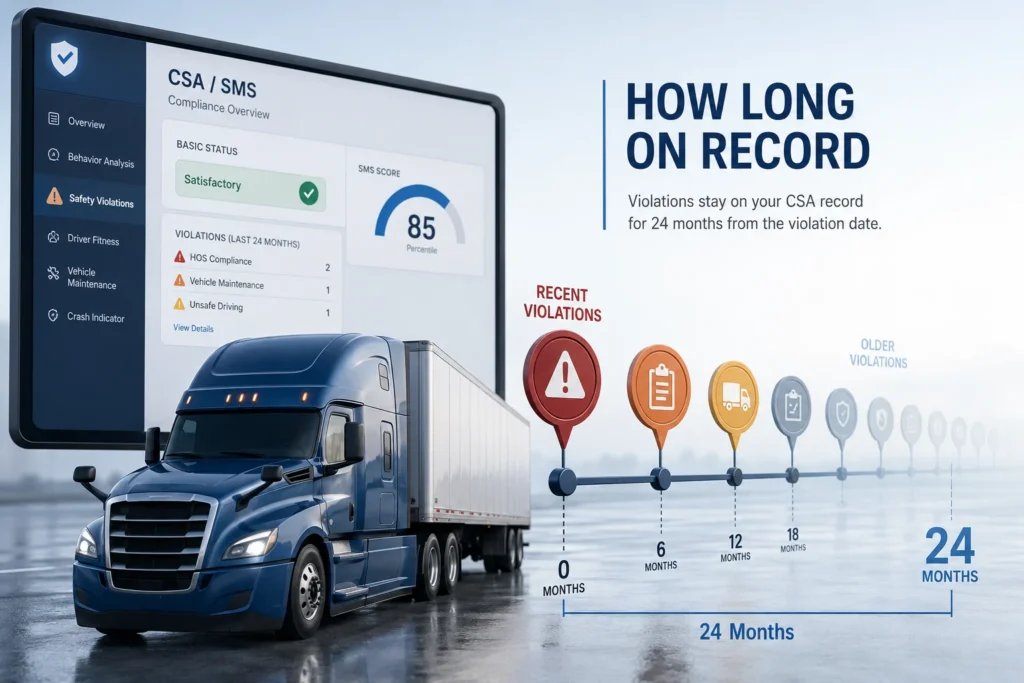
CSA violations have a major impact on a carrier profile or a driver PSP report. Violations impact changes over time. Their retention periods vary for carriers and drivers.
Driver records
Roadside inspection violations remain on a driver’s PSP report for 3 years. Crash-related violations are visible on the PSP report for 5 years. There is no multiplier applied to a driver violation. Employers can see this record for 3 to 5 years during the hiring process.
Carrier records
A company’s safety is checked through the Safety Measurement System (SMS). Violation points get severity weights, multipliers, and penalties, if applicable. These violations remain on the carrier profile for 24 months. This time window has a hard cutoff. All the violations are removed one day after the 24 months.
When severity weights lose impact
Severity weights lose impact only for the carrier profile. Violation impact decreases with time through the time-weight system. The Highest impact is for the first 6 months of violation. During this time, the base severity weight is multiplied by 3. The first drop in impact occurs from 6 to 12 months. The impact of the violation decreases from 3 times the base weight to 2 times the base weight. From 12 to 24 months, the impact drops from 2times to 1 time.
How CSA Violations Affect Drivers and Carriers
DOT audits
If the initial FMCSA intervention does not lower the BASIC percentile, FMCSA may order the carrier to submit to a formal audit. Violations with low severity weights can result in an off-site investigation. A carrier has to submit documents online in this case. A vehicle maintenance violation can cause a physical visit by an inspector. An inspector can also visit the company’s office and look at the extensive operational history.
Insurance premiums
Violations cause high CSA scores, which increase insurance premiums. Insurance premiums can skyrocket from 20% to 50%. This leads to a loss of thousands of dollars. Elite insurance also does not cover companies with poor safety performance.
FMCSA interventions
The FMCSA intervenes when the percentile ranking starts getting higher. The first formal notification is a warning letter. The next intervention is targeted roadside enforcement. The USDOT number is flagged in the nationwide weigh computer system. Inspectors pull that company’s truck for mandatory inspection. If the CSA scores are not low enough, the FMCSA issues a notice of violation. A notice of claim is issued for critical violations. It is a formal legal document that can result in civil penalties.
Employment opportunities
A faulty PSP report disqualifies a driver from a premium fleet. It forces them to work for low-paying companies, reducing earning potential. If they want to start their own business, insurance premiums are too high to cover.
Safety ratings
The FMCSA issues three official safety ratings. The FMCSA gives this rating after an on-site comprehensive audit or targeted investigation. Satisfactory is the highest possible safety rating. Conditional is the second-highest safety rating. It does not show enough safety measures. Most of the brokers do not work with these rated carriers. Unsatisfactory is the lowest rating. This rating results in a mandatory shutdown order in 45 days.
Improve Fleet Safety and Compliance with Max Dispatch

Understanding the severity weights of each BASIC category is important for motor carrier safety. Drivers and carriers find it difficult to stay compliant while managing operations and finding loads. Even if they follow most of the rules, a common missed violation can affect them for years. This is where Max Dispatch comes in to save carriers and drivers.
Max Dispatch finds loads for you and also helps you monitor your safety profile. Their experts inform you about the highest-severity violation. This helps you stay alert while driving and perform proper vehicle inspections. Working with Max Dispatch can help you maintain good safety performance and comply with the FMCSA rules.