

by Muhammad Rahat
Oct 27, 2026

Reviewed by Ford
Truck Dispatch Specialist
Every reefer truck owner wants high-paying reefer loads.
Owner-operators do find high-rate reefer loads but fail to earn a profit. This happens because they do not manage the reefer’s extra operational costs and deadheads or find backhaul opportunities.
In this article, you will learn why reefer loads may be more profitable than dry van loads. You will learn reefer rates and how to calculate reefer profit.
- Do Reefer Loads Pay More Than Dry Van Loads?
- How Much Do Reefer Loads Pay Per Mile?
- Why Do Reefer Loads Pay More?
- Reefer vs. Dry Van: Which Is More Profitable?
- How to Calculate Net Profit on a Reefer Load
- What Hidden Costs Reduce Reefer Trucking Profits?
- When Do Reefer Loads Pay More or Less?
- How to Find Higher-Paying Reefer Loads
- Is Reefer Trucking Worth It for Owner-Operators?
- Find Better-Paying Reefer Loads With Max Dispatch
Do Reefer Loads Pay More Than Dry Van Loads?

Yes, reefer loads pay more than dry van loads. It’s because reefer loads are perishable and require refrigerated equipment for delivery. Per-mile rates for reefer loads are higher in the spot market and lower on contracts. Reefer load rates also depend on lane, season, and loads-to-truck ratio.
How Much More Can Reefer Loads Pay Per Mile?
Reefer loads pay $0.3 to $0.6 per mile more than dry van loads. Moreover, this rate even rises to $1.0 per mile during harvest season. These rates alone do not determine the profit; they add up to total revenue. Net profit decides whether your reefer load made you good money or not.
What Determines the Reefer Pay Premium?

The reefer pay premium is determined by high-value cargo. This cargo includes food, meat, and pharmaceuticals. Produce season increases demand for reefer trucks to transport fruits and vegetables. Shippers pay high rates to avoid spoilage and deliver on time. Some regions have a small pool of reefer carriers. Owner-operators get premium rates there. Reefer trucks cost extra for operation and compliance, which also determines the reefer pay premium.
How Much Do Reefer Loads Pay Per Mile?

Reefer load rates depend upon the type of operation, whether it is a spot market load or contract load. Whether fuel charges are included or excluded also affects the reported rates. Next, you will see rates.
Reefer vs. Dry Van Spot Rates
The all-in spot rate (including fuel charges) for reefer loads is $3.62/mi, compared with $3.01/mi for dry van loads. So, all-in spot rates for reefer loads are $0.61/mi higher than those for dry van loads. Linehaul spot rate (excluding fuel) for reefer loads is $2.70/mi and for dry van loads $2.17/mi. For linehaul spot rates, the difference is $0.53 per mile.
Reefer vs. Dry Van Contract Rates
The all-in contract rate for reefer loads is $3.58/mi, and the dry van loads rate is $3.24/mi. Reefer loads pay $0.34 per mile more than dry van loads on contract. This rate is lower than the spot market rate but gives consistent revenue. Linehaul contract rates are $2.66/mi and $2.40/mi for reefer and dry van loads, respectively.
What Is a Good Reefer Rate Per Mile?
A good reefer rate per mile covers your reefer’s cost per mile and generates a profit. A reefer load rate between $3.20 and $3.59 per mile fulfills that criterion. A rate below $3.0 per mile is a loss, and you have to bear the truck maintenance cost.
Why Do Reefer Loads Pay More?

Reefer loads pay more due to the specialized conditions required for transporting temperature-sensitive goods. Moreover, the nature of loads and their on-time delivery needs make reefer loads expensive.
Specialized Equipment and Temperature Control
Shippers are willing to pay more for reefer loads because they want to transfer cargo in a temperature-controlled setting. To maintain temperature, trucks need special equipment and extra fuel. Reefers have extra maintenance costs as well due to this equipment. All these things increase reefer load pay.
Cargo Spoilage Risk and Delivery Requirements
Reefer cargo can spoil if temperature requirements are not maintained or deliveries are late. So shippers cannot delay transportation. It is their priority to deliver it as soon as possible. To avoid spoilage and deliver on time, they pay more for transportation.
Seasonal Demand and Available Reefer Capacity
In the peak produce season, demand for reefer trucks skyrockets. There are more reefer loads than available trucks. This again increases rates for reefer loads. That seasonal demand is region- and time-specific.
Reefer vs. Dry Van: Which Is More Profitable?

Neither reefer loads nor dry van loads are better. It all depends upon net profit, your lane, and business strategy. The following comparison can help you make a decision.
Rate Per Mile and Gross Revenue
Reefer loads have higher rates per mile, which also increases gross revenue. Reefer loads give $.61/mi higher rate, resulting in a gross revenue advantage of $610 over 1000 miles. The revenue advantage looks attractive, but that’s not the only thing that determines profitability.
Fuel, Maintenance, and Equipment Expenses
Reefers consume more fuel than dry van trucks. The reefer unit in a reefer has its own engine, belt, compressor, sensor, and cooling unit. All these components require proper service and increase the maintenance cost. Reefer trailers cost more to purchase and lease compared to dry van trailers. Reefers also require higher insurance premiums.
Load Availability, Deadhead, and Backhauls
Dry van trailers carry a variety of loads, so load availability remains constant throughout the year. Reefer transport focuses on temperature-sensitive materials, and reefer load availability varies by season and region.
Dry van equipment faces fewer deadheads. That applies to reefer loads when your lane serves a larger distribution center or an agricultural region. Dry van loads have available backhauls irrespective of season. Backhauls are more in produce season for reefer loads.
Detention Time and Accessorial Charges
Detention time is the waiting time at the shipping or receiving facility beyond the allowed time. It happens because of loading, unloading, or waiting for dock availability. Both types of equipment face detention time. Reefers incur profit loss as their refrigeration keeps running.
Accessorial charges are additional fees besides the base freight rate. They are received for extra service, detentions, and changes to equipment. Carriers may qualify for these charges depending upon the broker’s policy and rate confirmation.
How to Calculate Net Profit on a Reefer Load
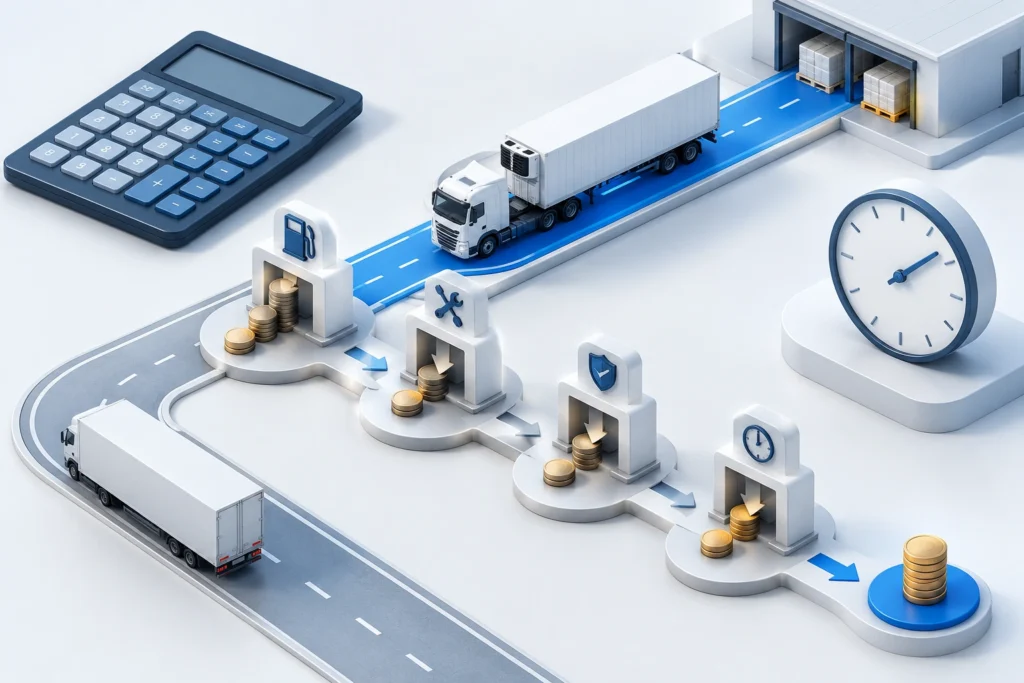
Rate per mile does not determine the profitability of a reefer load. This section explains how to calculate net profit on reefer loads.
Calculate Total Revenue From the Load
To calculate total revenue, multiply the rate per mile by the total miles for that trip. If the broker agreed to accessorial payments, then add that to total revenue.
Formula:
Total revenue = Base freight payment + Approved accessorial payments
Subtract Fuel, Deadhead, and Reefer Unit Costs
Reefer fuel costs are much higher than those for a dry van truck. Both the Reefer truck and the refrigeration unit burn fuel. If there are deadheads, then those will also increase fuel cost. Calculate deadhead miles and their fuel cost, then add that cost to the tractor’s fuel cost.
Formula:
Total fuel cost = Tractor fuel cost + Reefer unit fuel cost
Account for Maintenance, Insurance, Washouts, and Other Fees
In addition to the fuel cost, calculate the following:
- Maintenance and tire costs
- Insurance
- Washout fees
- Dispatch fees
- Tolls and permits
- Driver compensation
- Truck and trailer payments
- Registration and other overhead costs
Until now, you have learned to calculate expenses and total revenue. Next, you can calculate the net profit.
Formula:
Net profit = Total revenue − Total expenses
Compare Net Profit Per Mile and Per Working Hour
Once you know the net profit, measure it per mile and per working hour. Then compare these figures across loads to evaluate mileage, waiting time, and profitability.
Formulas for net profit per mile and per working hour:
Net Profit per Mile = Net Profit ÷ Total Miles Driven (loaded + deadhead)
Net Profit per Hour = Net Profit ÷ Total Working Hours
What Hidden Costs Reduce Reefer Trucking Profits?

Owner-operators should consider the following costs and manage them to maintain profitability.
Reefer Fuel, Pre-Cooling, and Maintenance
The refrigerator unit increases fuel costs. Reefer freight loading requires pre-cooling that further raises fuel cost. Repair to the refrigerator sensors, compressor, or other components is very expensive. Collectively, these reduce the reefer profit.
Washouts, Lumper Fees, and Detention
Reefers need washouts between shipments. Driving to a truck-wash facility and paying for the wash increases costs. Third-party freight handlers charge carriers for their service. Detention also increases cost in the form of fuel and delayed delivery.
When Do Reefer Loads Pay More or Less?
Reefer load pay is conditional. Key factors include season, lane, deadhead, and backhauls.
Produce Season and Seasonal Demand
During the peak produce season, reefer rates go up. California, Texas, and Florida generate demand for reefer transportation. Reefer load numbers exceed the number of reefer trucks. Owner-operators can earn higher profits during this season.
Weak Lanes, Deadhead Miles, and Poor Backhauls
To make a reefer load profitable, you should avoid lanes with low rates. If you have to travel far to pick up a reefer load and return home without carrying any loads, a high-rate headhaul may not generate enough profit to cover the total trip costs.
How to Find Higher-Paying Reefer Loads

Owner-operators can find higher-paying reefer loads by following the given steps.
- Compare Rates on Load Boards
- Target High-Demand Reefer Lanes
- Monitor Seasonal Demand
- Negotiate Rates With Brokers
- Confirm Accessorial Charges
- Minimize Deadhead Miles
- Secure Backhaul Loads
- Calculate Total Operating Costs
- Compare Net Profit Per Mile and Hour
- Build Relationships With Reliable Brokers
Is Reefer Trucking Worth It for Owner-Operators?

Reefer trucking is worth it when demand is high. It should cover the operational costs and give net profit. Owner-operators should have strong lanes with good backhaul opportunities. Owner-operators looking for consistent loads with fixed rates can choose dry van loads. It saves them from extra operational and maintenance costs.
Find Better-Paying Reefer Loads With Max Dispatch
Finding rates and securing reefer loads are quite time-consuming tasks. But Max Dispatch saves you from extra effort. Our experts identify available freight rates and calculate net profit per load. Not only does Max Dispatch find high-paying loads, but it also secures backhauls. We leave no stone unturned to maximize your profit.