

by Faizan Hassan
Dec 12, 2025

Reviewed by Ford
Truck Dispatch Specialist
According to FMCSA truck driver English proficiency data, only a small fraction of U.S. truck drivers truly lack English proficiency. The actual number of drivers who don’t speak English at the level required by federal standards is around 130,000–140,000.
The demographics show that about 3.8% of licensed CDL holders are “limited English proficient”. With roughly 3.5 million drivers nationwide, 3.8% corresponds to approximately 130,000 drivers who may not speak English fluently.
By comparison, over 96% of drivers meet the English rule’s standards. Enforcement statistics underscore this: for example, news reports found about 7,248 drivers taken out of service for English violations from June to October 2025 alone.
- Key Statistics — English Proficiency in U.S. Trucking (2026)
- Language Proficiency in the U.S. Trucking Workforce
- How the Number of Non-English Drivers Has Changed Over Time
- Where Most Non-English-Speaking Truck Drivers Operate
- Enforcement Patterns & CDL Language Requirements
- How English Skills in U.S. Trucking Compare to Other Countries
- Conclusion
Key Statistics — English Proficiency in U.S. Trucking (2026)
- 3.8% of U.S. CDL holders are limited English proficient (LEP).
- With 3.5–3.6 million active truck drivers, that equals 130,000–140,000 drivers with limited English skills.
- 96% of U.S. drivers meet federal English-proficiency rules.
- 23,000 English-language deficiency citations issued since June 2025.
- 6,500–7,248 drivers were placed out of service (OOS) for English violations (28% of citations).
- Florida — Top 10, major spike after August 2025 crash
- 18% of U.S. truck drivers are foreign-born (648,000).
- The foreign-born driver population increased from 316,000 (2000) → 720,000+ (2021) → 648,000 (2024–2025).
- Over 20 U.S. states offer the CDL written test in Spanish.
Language Proficiency in the U.S. Trucking Workforce
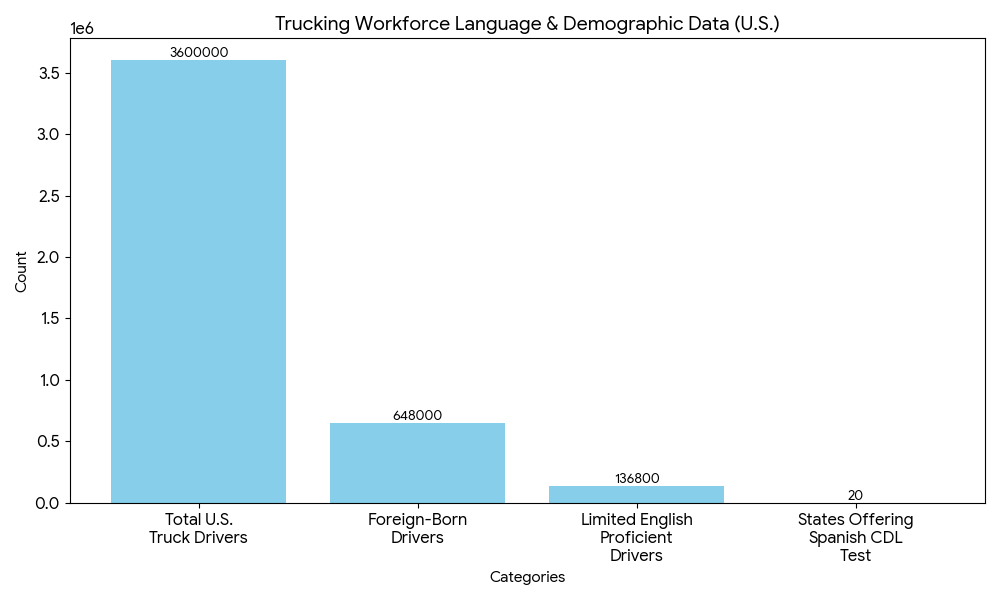
Enforcement data and census surveys confirm that only a small share of drivers fall short: FMCSA reports that about 3.8% of CDL holders are limited English proficient. For context, the U.S. trucking workforce is quite diverse.
Bureau of Labor Statistics figures indicate roughly 3.8% of 3.6 million, it’s about 136,800 U.S. truck drivers, are limited English proficient.
Therefore, 3.8% equates to approximately 130,000 individuals who may not speak English “very well.” About 18% 648,000, of U.S. drivers are foreign-born, many coming from Latin America, the Caribbean, or Asia. Reflecting this diversity, over 20 states now offer the CDL knowledge test in Spanish.
In practice, however, nearly all immigrant drivers pass the English requirement: only a few percent of the workforce is officially classified as limited-English proficient.
How the Number of Non-English Drivers Has Changed Over Time
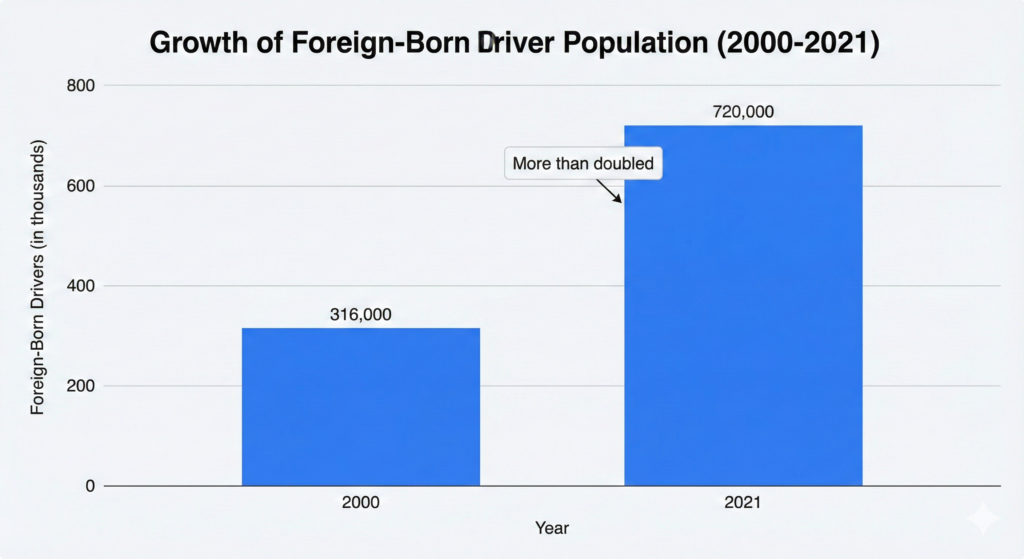
Industry research shows the foreign‐born driver population more than doubled from about 316,000 in 2000 to over 720,000 by 2021. BLS data put foreign‐born drivers at roughly 18% of the total today. This trend reflects a long-term effort to attract new workers from abroad amid a trucker shortage.
Foreign-Born / Non-English Drivers Over Time
| Year | Foreign-Born Drivers |
| 2000 | 315,981 |
| 2021 | 720,000+ |
| 2024–2025 | 648,000 |
Where Most Non-English-Speaking Truck Drivers Operate
Non-English proficiency violations are concentrated in certain U.S. regions. The latest data show the South and Southwest leading enforcement.
| Region / State | English-Related Out-of-Service (OOS) Violations |
| Texas | 582 |
| Wyoming | 469 |
| Tennessee | 397 |
| Arizona | 361 |
| Florida | 8th nationwide |
Minnesota and Alaska recorded almost zero English-related OOS orders by late 2025. In summary, the data indicate that non-English speaking drivers are predominantly found along Southern/Southwestern routes.
While the Pacific coast and northern regions have been largely unaffected in enforcement statistics, they show minimal English-related OOS activity.
Source: InfinitiWorkForce
Enforcement Patterns & CDL Language Requirements
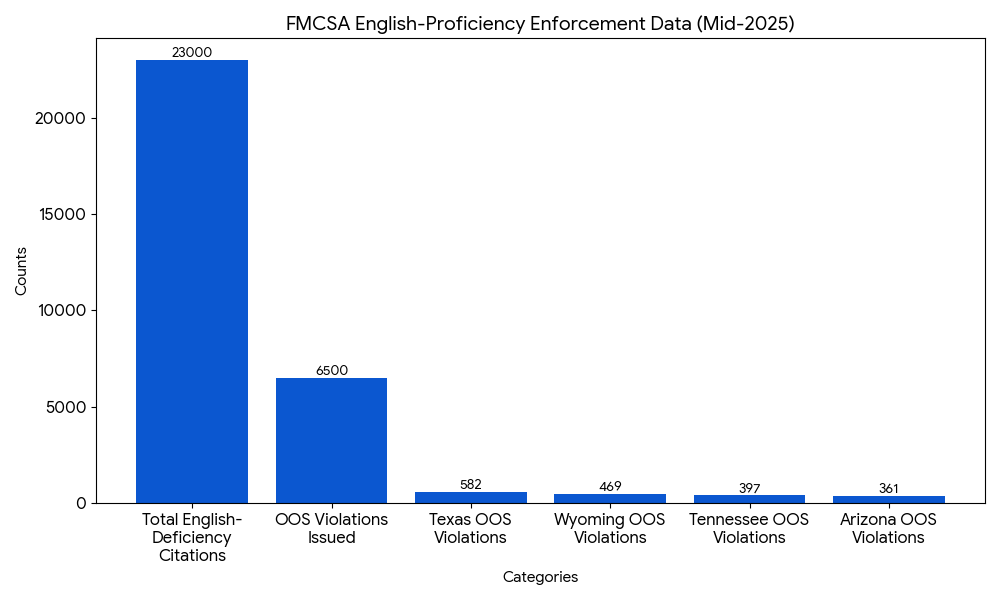
In mid-2025, the FMCSA reinstated English proficiency as an out-of-service (OOS) violation for CMV drivers. Since June 25, over 23,000 English-language deficiency citations were recorded, but only 28% of those (about 6,500 drivers) were actually taken OOS.
Enforcement varies sharply by region. For example, Texas leads with 582 English-proficiency OOS violations, followed by Wyoming (469), Tennessee (397), and Arizona (361).
Florida surged into the top ten for English-proficiency OOS violations after an August 2025 crash prompted new enforcement. By contrast, states like California, Minnesota, and Alaska issued virtually no ELP OOS citations in that period.
Dozens of states (e.g., Alabama, Arizona, California, Florida, Illinois, New York, Pennsylvania, Texas, etc.) already offer the written CDL exam in Spanish, and a few in additional languages.
However, the practical road test and on-the-road inspections require English. Inspectors conduct the ELP interview only in English. In short, many states allow Spanish for the written test, but the driving exam itself is strictly English-only.
Sources: FMCSA, TodayFtrIntel
How English Skills in U.S. Trucking Compare to Other Countries
Trucking has an unusually high share of immigrant and limited-English drivers compared to many industries. In the U.S., the Bureau of Labor Statistics and industry groups estimate about 18% of truck drivers are foreign-born, slightly above the 17% immigrant share of all U.S. workers. Many new entrants are from Central America, the Caribbean, or Asia, reflecting recruitment into freight jobs.
Canada’s Bilingual Workforce & EU Multilingual Trucking
By contrast, countries like Canada and members of the EU have different linguistic norms. Canada’s system is officially bilingual, and cross-border rules treat French-speaking individuals.
Canadians are the same as others: they must meet the English requirement when operating in the U.S. In Europe, drivers typically speak multiple languages (e.g., German or Polish drivers often also use English or the local lingua franca).
Middle East Reliance on Non-English Drivers
In parts of the Middle East and Asia, truck fleets have long relied on drivers from South or Southeast Asia who may have limited English, but local enforcement does not use English as the sole test language.
Large Carriers Enforce Stricter English Proficiency Testing
Within the U.S. industry itself, smaller fleets and owner-operators tend to include a higher proportion of immigrant drivers, while large carriers often impose stricter hiring screens. Industry groups have largely coalesced around safety.
The American Trucking Associations (representing major carriers) have urged Congress to strengthen qualification standards for all CMV drivers. This broad support suggests that both large and small fleets view clear English communication. This important contrast helps explain why transportation is at the center of this language debate.
Sources: Natso, TruckingDive, TruckNews
Conclusion
U.S. enforcement of English-proficiency rules is intensifying, especially in border states, but only a small share of drivers ultimately face removal. Compared globally, the U.S. remains stricter than Canada or the EU.
Despite debate over safety and labor impact, regulators and industry agree: English proficiency will remain a core trucking requirement.