

by Muhammad Rahat
July 30, 2026

Reviewed by Ford
Truck Dispatch Specialist
Rules and regulations for truckers do not remain static. They keep changing, and 2026 proves it. If you are operating under old rules, your driving career is in danger.
Non-compliance with new rules can cost you more than a warning. An outdated medical certificate, an error in the logging device, and a lack of English language proficiency are red flags. They can put you out of service, result in thousand-dollar fines, and halt your operating authority.
In this article, you will learn about all the rules and their impact on truckers. You will come to know what has changed and what has not. You will also learn how you can stay ahead with this knowledge.
What Are the New Laws for Truckers in 2026?
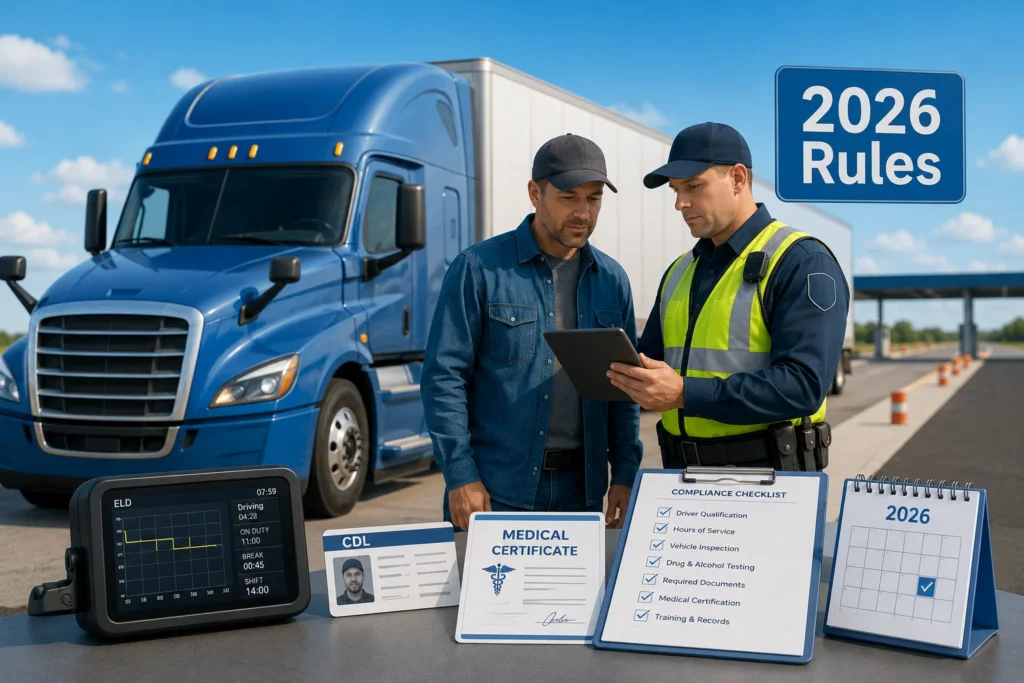
2026 is a significant year for FMCSA regulations. FMCSA has shifted to an electronic system for much of its trucking oversight. This reduces the chance of errors or delays in drivers’ documents or hours-of-service records.
FMCSA presented a mix of new rules, enforcement updates, and proposed rules. Understanding their differences is important, as misunderstanding them can cost you many dollars. New rules are the ones that have been officially approved, and drivers have to follow them. Enforcement is the implementation of already established rules. The proposed rules are under discussion and have not been finalised.
These rules mainly affect the finances and operational authority of truck drivers. There are financial rules for brokers and freight forwarders. The new regulations affect carriers, company drivers, and owner-operators differently.
Key New Trucking Laws and FMCSA Rule Changes for 2026
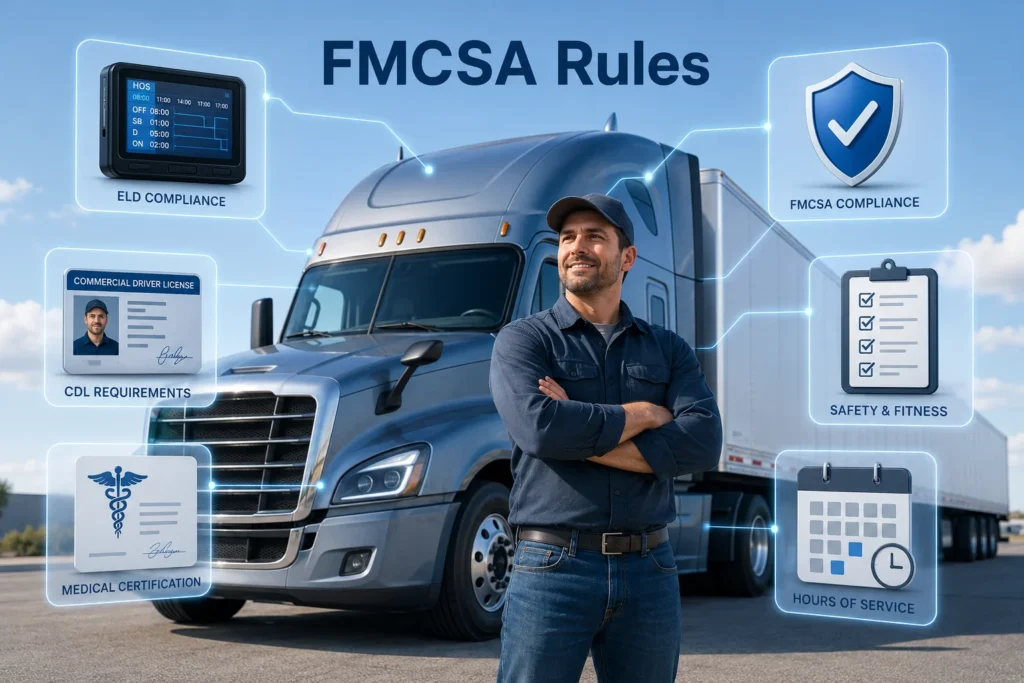
FMCSA has introduced a wide range of updates to rules and regulations for truck drivers. Some of these have been implemented since early 2026. Some rules are under discussion. These affect a driver’s ride from the start. The sections below describe them in detail.
Non-Domiciled CDL Rules Are Now Much Stricter
In 2026, non-domiciled commercial driver’s license holders are subject to new eligibility requirements for working in the U.S. These rules apply to non-state drivers and foreign drivers. States that do not implement new rules must stop issuing affected licenses. FMCSA estimates these rules can remove approximately 200,000 commercial driver licenses.
Eligibility will be limited to drivers with qualifying non-immigrant status. This rule also requires “non-domicile” to appear on official documents instead of “limited” or “temporary”. States must verify the immigration status of drivers. You have to appear in person to renew your license instead of applying online.
English Language Proficiency (ELP) Enforcement Returns
In 2016, President Obama implemented a policy under which violations of the English language proficiency requirement would not put you out of service. But in 2025, President Trump restored enforcement of ELP requirements for drivers. Those drivers who cannot understand English will be out of service. FMCSA is revising the English Language Proficiency enforcement policy multiple times this year.
Hours-of-Service (HOS) Enforcement Has Tightened
FMCSA has strengthened hours-of-service enforcement. FMCSA uses automated electronic logging device (ELD) data to check for violations. If your truck is waiting at the dock for loading or unloading, that time will not be counted as a break. Your loading delay time will be included in your hours of service calculation. If you exceed those hours, there will be penalties.
Exceeding the 11-hour driving limit can cost you $500-$1,000. Crossing the 14-hour duty time limit causes a penalty from $750 to $1,500. If your ELD data is found to be false, you will pay $1,000 to $5,000 and receive a criminal referral.
Short-Haul Driver Rule Updates
Short-haul drivers received some benefits. The final rule expanded the air mile radius from 100 to 150. Their duty hours also increased from 12 to 14. They can work 2 hours of extra time if the driving conditions are not good.
Medical Certification Goes Digital (NRII)
Medical certificates will not be accepted in paper form under the new electronic submission process. This FMCSA rule supports the National Registry II system. Digital certificates are easy to share between states. To avoid disruption, FMCSA allows medical certificates in paper form for 60 days. This only affects the transmission method, not the physical qualification standards.
ELD Compliance Rules Become More Strict
FMCSA authorized roadside officers to immediately place a driver out of service if his ELD has been revoked from the registered list. This will be effective from February 2026. Fines for non-compliant devices are from $1,000 to $16,000. Drivers should check their device quarterly online.
Broker and Freight Forwarder Regulation Updates
Rules under 49 CFR Part 387 clarified trust and bond requirements for brokers and freight forwarders. The minimum bond/trust requirement for brokers and freight forwarders is $75,000. FMCSA is discussing raising it but has not yet decided. Carriers have access to brokers’ bond status. They can benefit by filing a claim against the bond if brokers fail to pay. These financial rules are in effect from January 2026.
New Administrative and Deregulatory Changes
Some of the deregulatory and administrative changes include:
- Electronic driver vehicle inspection reports are replacing paper DVIRs, which will save more than 10 minutes per report
- Flares and spare fuses are no longer required as emergency equipment; reflective triangles and a charged fire extinguisher are still mandatory.
- License plate lighting is not required when towing a trailer; certain tire load marking and rear impact guard labeling requirements were removed.
- FMCSA is migrating its registration platform to a new system. Meanwhile, the current system will also be active to avoid delays.
- Drug and Alcohol Clearinghouse identity verification is now stronger for newly registered user roles.
Automated Truck Rules Still Pending
Automated driving system-equipped commercial vehicles do not have FMCSA-specific rules. FMCSA is expected to complete inspection and maintenance standards in 2026. They will cover the software checks, sensor calibration, and human fallback protocols. There is a proposed rule to install heavy vehicle automated emergency brakes. Carriers are not obliged to install them for now.
FMCSA Crackdown on CDL Schools and New Carriers
FMCSA is planning to shut down many training schools. These schools do not meet the requirements for curriculum and equipment. Administrator Barrs intends to increase supervision of commercial driver license training to improve quality. The agency is also planning to implement the 2012 statutory mandate. That requires new entrants to demonstrate operational safety before getting authority. FMCSA will take action against CDL fraud, non-compliant ELD providers, and chameleon carriers.
What Has Not Changed for Truck Drivers?
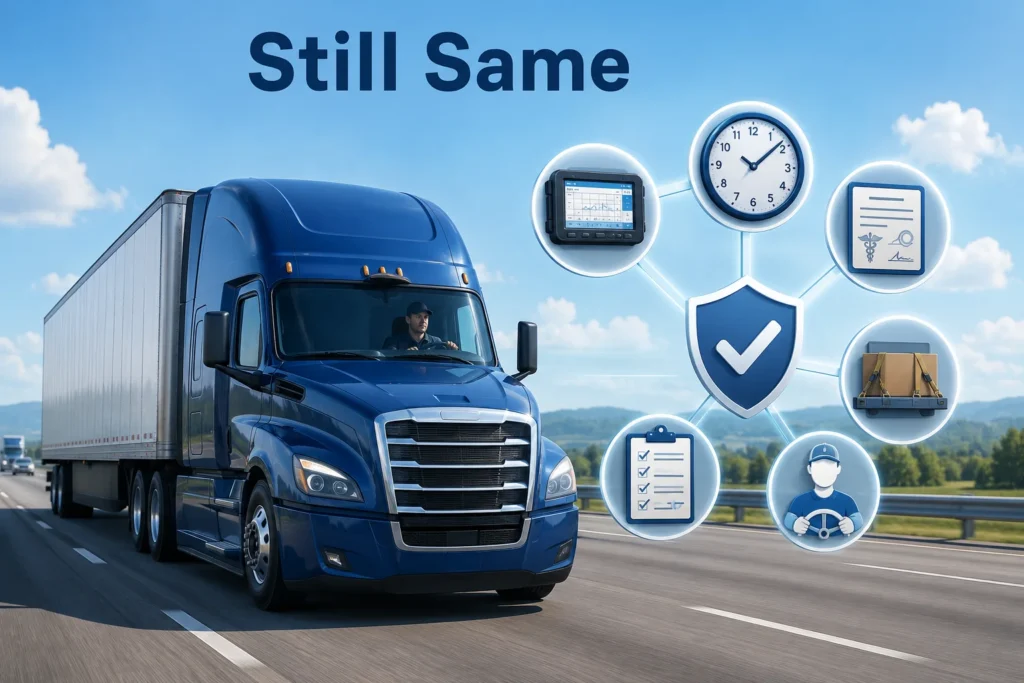
Although FMCSA introduced new rules, many regulations remain the same. Hours-of-service limits continue to follow current regulations. There is no increase or decrease in hours. Medical qualification standards are the same, but the certificate is now submitted digitally. Alcohol and drug testing will continue as before.
Current Hours-of-Service Limits Still Apply
FMCSA has modified many rules. They have not extended or decreased the hours-of-service limits. Working hours remain the same. There is an 11-hour driving limit after 10 consecutive hours off-duty. The 14-hour driving window remains unaffected. You can’t drive beyond the 14-hour limit. There are exceptions to this rule. There is some flexibility under the hours-of-service rule for short-haul drivers. So, drivers will continue following the existing HOS rules.
Existing Break Rules Remain in Effect
In 2026, break rules have not changed. Taking a break during continuous driving is mandatory. You are required to take a 30-minute break after 8 consecutive hours of driving. According to current rules, off-duty, on-duty but not driving, and certain qualifying non-driving periods count as breaks. After that period, you can continue driving according to the hours-of-service rule. You should ensure ELD accuracy to avoid compliance issues.
Weekly Driving Limits Stay the Same
FMCSA has not altered weekly driving limits. Restart requirements are also the same. There is a 60-hour weekly driving limit if you work 7 days per week. For 8 days of work, the driving limit increases to 70 hours. Drivers can reset these limits. The 34-hour off-duty time is the requirement to reset the weekly working hour limit. Interstate commercial drivers will follow these current weekly driving limits. Harsh weather conditions get an exception.
Most Core FMCSA Regulations Are Still Unchanged
Beyond the hours-of-service rules, most of the core regulations are unchanged. These are the main requirements for a driver to work in the U.S. One of these is the medical certification requirement. A certified medical examiner gives it after assessing the driver. He examines your eyesight, hearing, cardiovascular health, diabetes, neurological disorder, and respiratory disease. These assessments are based on current regulations.
Alcohol and drug testing requirements are also not updated in 2026. New drivers will be tested pre-employment. Existing drivers will be checked randomly and at return-to-duty times. Cargo securement regulations have not changed. Drivers should follow old FMCSA cargo safety standards.
How These New Trucking Laws Affect Drivers and Owner-Operators
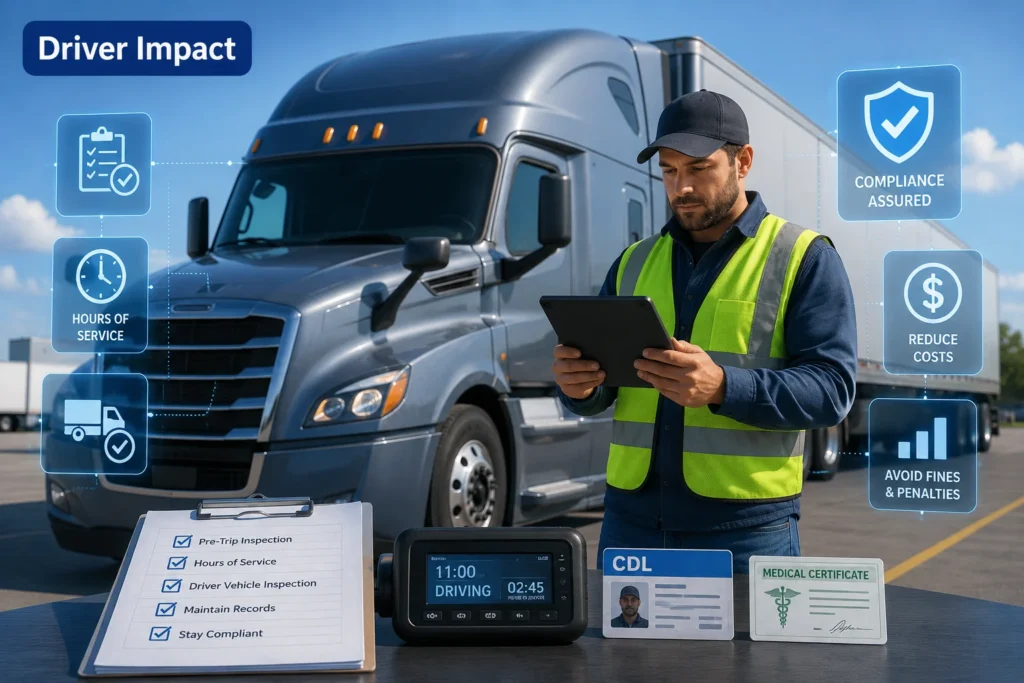
New rules create extra compliance responsibilities for drivers and owner-operators. As most of the paperwork is going to be digital, strict compliance is mandatory. You need to know all the rules and regulations to start as a driver. Your driver training institute matters. You should prepare documents appropriately and on time.
Compliance Costs
It can be costly to stay compliant with the new rules. English Language Proficiency requires learning and taking English language tests. It costs hundreds of dollars. A digital medical certificate will have its own issuing and renewal charges. You have to keep your electronic logging device up to date. This again will cost you money. A driver has to calculate compliance costs carefully for profitability.
Renewal Planning
Medical certificates, commercial driver’s licenses, and domicile documentation are all under digital tracking. You cannot miss a renewal time window. You should plan renewal 60 to 90 days before the expiry date. Any outdated document can end your working rights.
Avoiding Violations and Fines
There are fines for violations of new FMCSA rules. Expired documents can cause fines and renewal costs. Keep checking hours-of-service logs. You should ensure broker and financial paperwork complies with current requirements. These simple steps can help identify problems before the system detects them.
Staying Eligible to Operate
A driver has to follow all the regulations to be eligible for work. Previously, roadside checks were enough. Now you need verification of all the documents before even starting. You need to review your documents periodically to stay eligible. A little carelessness can affect the whole operation.
Stay Ahead of New FMCSA Regulations with Max Dispatch
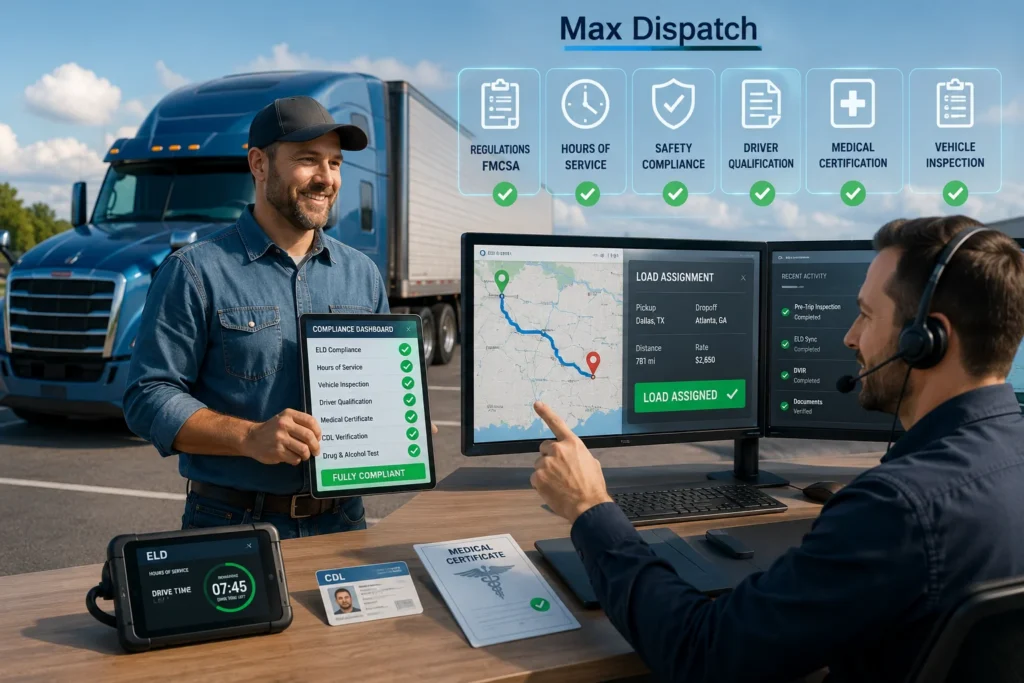
For a driver, it’s not easy to get all the updates on new FMCSA regulations. Then compliance becomes difficult when you don’t even know the rules. That is where Max Dispatch saves you. Their experts not only find loads for you but also help you stay compliant with new regulations.
Before booking loads, Max Dispatch checks that the CDL, medical certificate, and domicile paperwork are current. They are aware of FMCSA rules and regulations. Max Dispatch monitors new changes and passes them on to drivers in plain, understandable English. So, with Max Dispatch, you never have to worry about FMCSA regulation violations.