

by Muhammad Zubair
May 28, 2026

Reviewed by Ford
Truck Dispatch Specialist
Starting a trucking company or applying for FMCSA operating authority can be confusing because businesses must complete multiple compliance requirements before legally operating in interstate commerce. Many motor carriers, freight brokers, and freight forwarders struggle to understand BOC-3 filing requirements and process-agent rules, and even small filing mistakes can delay FMCSA authority activation and prevent legal interstate operations. This guide explains BOC-3 filing requirements, process agents, FMCSA compliance, MC authority activation, exemptions, updates, and common filing mistakes in a simple and structured way.
What Is a BOC-3 Filing?
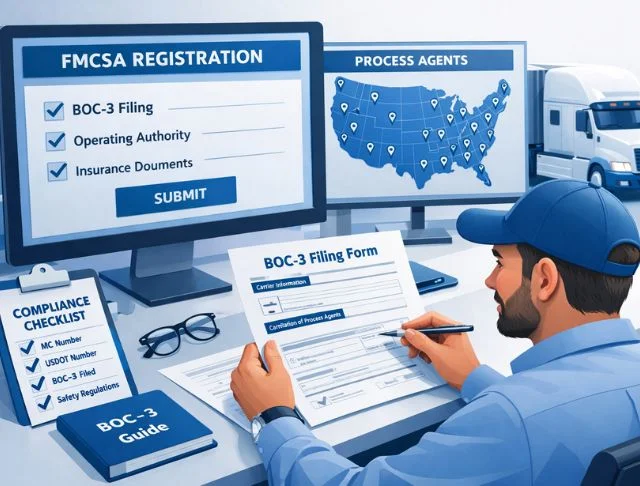
BOC-3, which stands for “Blanket of Coverage,” is a federally mandated FMCSA (Federal Motor Carrier Safety Administration) compliance document used in the commercial transportation and trucking industry to designate process agents for motor carriers, freight brokers, freight forwarders, and household goods brokers operating in interstate commerce. This BOC-3 filing creates a legal representation network that allows transportation companies to receive legal documents in every state where they operate.
The Federal Motor Carrier Safety Administration requires this filing before operating authority becomes active because carriers must maintain a valid service-of-process system across all operating jurisdictions. Without a properly submitted BOC-3 filing, the FMCSA keeps the MC (Motor Carrier) operating authority in pending or inactive status because the carrier has not yet designated the legally required process agents for interstate operations.
What Is the Purpose of a BOC-3 Filing?
The main purpose of a BOC-3 filing is to appoint process agents who can legally receive court notices, summons, subpoenas, and other official legal documents on behalf of a transportation company. These process agents act as legal representatives for carriers, brokers, and freight forwarders in each state where they operate to help them stay compliant with interstate regulations.
A BOC-3 filing also provides nationwide legal coverage for transportation companies. The FMCSA requires them to have process agents in every state where they do business since interstate carriers operate across multiple states. This filing also helps to activate the FMCSA operating authority linked to an MC (Motor Carrier) number because the authority remains inactive until a valid BOC-3 is submitted.
This BOC-3 filing also ensures that carriers, brokers, and freight forwarders can always be legally contacted during lawsuits, audits, or regulatory actions. It supports the legal process by making sure official documents are delivered to the correct representatives in each state.
Why Is BOC-3 Filing Required Before Operating?
A BOC-3 filing is required before operating because the FMCSA will not activate a company’s operating authority without it. It is a mandatory compliance step linked to the MC (Motor Carrier) number approval process, along with insurance filings and other FMCSA requirements.
It is required because it designates process agents in every state where a carrier, broker, or freight forwarder may operate. These agents ensure the company can legally receive court notices, subpoenas, and official documents anywhere in the United States, which is essential for interstate commerce compliance.
The operating authority stays inactive or pending without a completed BOC-3 filing, which means the transportation company is not legally allowed to start interstate transportation operations.
Who Needs a BOC-3 Filing?
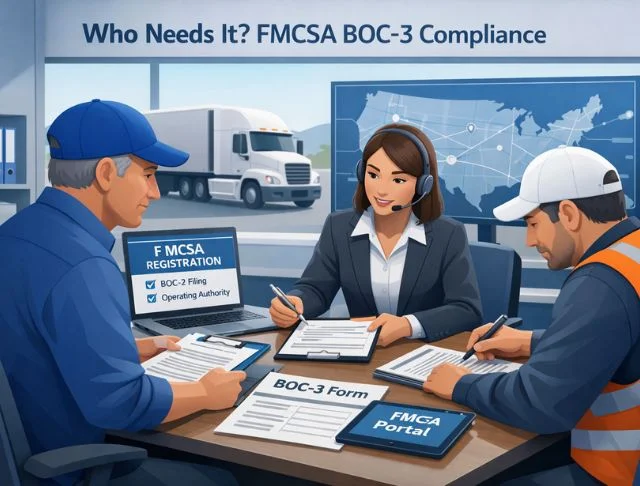
A BOC-3 filing is required for all FMCSA-regulated entities operating under interstate commerce authority, including motor carriers, freight brokers, freight forwarders, and household goods brokers that conduct transportation activities across state lines. This filing is part of the FMCSA operating authority process and confirms that each business has process agents assigned in every state to receive legal notices such as summons, subpoenas, and regulatory correspondence. Freight brokers, freight forwarders, and household goods brokers must complete this filing before their authority becomes active, as it verifies they can be legally contacted for transportation-related agreements, disputes, and compliance matters.
What Is a Process Agent?
A process agent is an individual or company authorized by FMCSA regulations to receive and accept official legal documents on behalf of a transportation business in a specific state where it operates. Official legal documents include summons, subpoenas, court notices, legal complaints, lawsuits, tax notices, compliance notices, and other service-of-process or regulatory communications related to interstate transportation operations.
A process agent maintains a valid physical address within the assigned state and acts as the official legal contact point for motor carriers, freight brokers, freight forwarders, and household goods brokers. This system allows transportation companies operating across multiple states to remain legally reachable without maintaining physical offices in every jurisdiction. The FMCSA requires transportation companies to appoint process agents in every operating state through a BOC-3 filing to maintain legal representation and compliance in interstate commerce.
What Legal Documents Can a Process Agent Receive?
Process agents are legally authorized to receive various official and legal documents on behalf of transportation companies and forward them to the business for legal response, compliance action, or regulatory handling. Process agents can receive the documents which are given below.
- Summons
- Subpoenas
- Court notices
- Legal complaints
- Government correspondence
- Service-of-process documents
How BOC-3 Filing Works
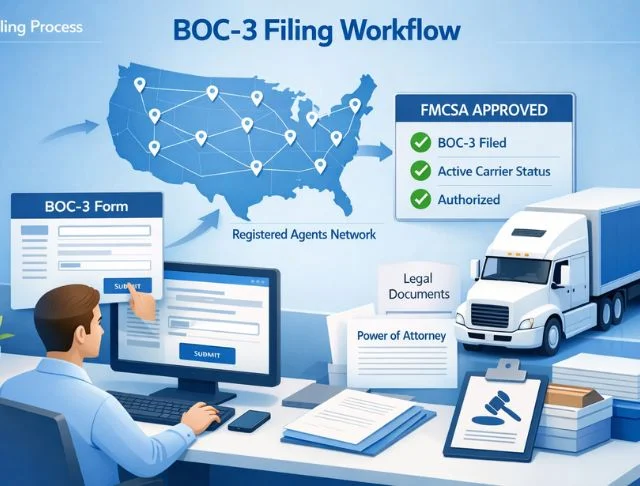
The BOC-3 filing process begins after a transportation company applies for FMCSA operating authority and receives an MC (Motor Carrier) number. The applicant then submits a BOC-3 form through an FMCSA-approved filing system or an authorized third-party filing provider by designating process agents in every required operating state. Once the filing is submitted electronically, the FMCSA reviews and records the information to verify that the company has valid nationwide legal representation for interstate operations.
After successful verification, the BOC-3 filing becomes part of the company’s FMCSA compliance records and helps activate the associated operating authority along with required insurance filings. Many third-party providers also offer same-day electronic filing services to speed up the authority activation process.
What Information Is Needed for a BOC-3 Filing?
Applicants need the following information before completing a BOC-3 filing.
- MC (Motor Carrier) number
- USDOT number (United States Department of Transportation)
- Business name
- Company address
- Contact information
- Process agent details
How Long Does B/lOC-3 Filing Take?
A BOC-3 filing is usually processed shortly after it is electronically submitted to the FMCSA, and many third-party filing companies offer same-day filing services. However, the exact processing time depends on whether the submitted information is accurate and whether all related compliance requirements, such as insurance filings, have been completed successfully.
Incorrect information, missing details, or unresolved insurance filings may delay the FMCSA review process. FMCSA operating authority connected to the MC (Motor Carrier) number remains in pending or inactive status until the BOC-3 filing and all compliance requirements are fully approved.
BOC-3 Filing and FMCSA Operating Authority
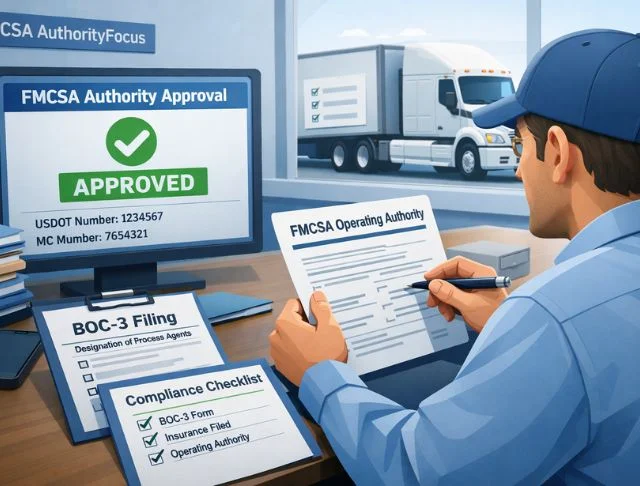
A BOC-3 filing works together with FMCSA registration records and insurance filings to activate MC (Motor Carrier) operating authority for interstate transportation businesses. FMCSA operating authority changes from pending status to active status once the FMCSA receives a valid BOC-3 filing and all required compliance documents. Interstate carriers, freight brokers, and freight forwarders cannot legally operate under federal interstate authority without a valid BOC-3 filing. Failure to file a BOC-3 may result in delayed authority activation, regulatory violations, compliance penalties, legal operation restrictions, and loss of business opportunities.
What Is the Difference Between MC Number, USDOT Number, and BOC-3?
Many transportation companies confuse these three FMCSA compliance requirements, but each one serves a different purpose in the registration and operating authority system. A USDOT (United States Department of Transportation) number is used to identify a transportation company for safety monitoring, inspections, and regulatory tracking of its operations and performance. It is mainly for data collection and compliance oversight.
An MC (Motor Carrier) number is issued by the FMCSA and grants a company legal authority to operate in interstate commerce, such as transporting freight across state lines or arranging shipments as a broker or freight forwarder. A BOC-3 filing is the compliance document that designates process agents in all operating states. It is required to activate the MC operating authority by ensuring the company can receive legal documents and official notices nationwide.
BOC-3 Filing vs Other FMCSA Requirements
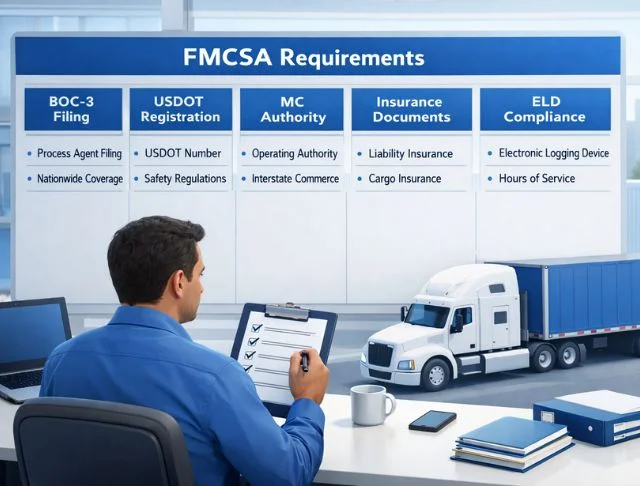
The structured comparison of key FMCSA compliance requirements, such as the BOC-3 Filing, UCR (Unified Carrier Registration), and the MCS-150 Form, highlights their individual purpose, regulatory coverage, renewal frequency, and their specific role within FMCSA compliance.
You can easily understand the difference between BOC-3 filing and other FMCSA requirements through the table given below.
| FMCSA Compliance Requirements | BOC-3 Filing | UCR (Unified Carrier Registration) | MCS-150 Form |
| Purpose of Requirement | Establishes legal process-agent coverage required for FMCSA operating authority | Annual federal registration program for interstate transportation businesses | Updates and maintains USDOT registration and company information |
| What It Covers | Designation of process agents in all operating states to receive legal documents such as summons, subpoenas, court notices, and regulatory correspondence | Registration of motor carriers, freight brokers, and freight forwarders for federal fee-based compliance tracking | Company operational data such as fleet size, mileage, address, and business structure details |
| Renewal Type | Generally one-time filing unless business or process-agent information changes | Renewed annually | Updated every 24 months or when changes occur |
| Primary Role in FMCSA Compliance | Activates FMCSA operating authority and ensures nationwide legal representation for interstate operations | Confirms legal registration and compliance for interstate commercial operations under federal law | Ensures accurate USDOT safety, identification, and enforcement records within FMCSA systems |
Which FMCSA Filings Are Required Before Operating?
FMCSA filings, which are required before interstate operations, are given below.
- USDOT registration
- MC authority application
- Insurance filing
- BOC-3 filing
- Unified Carrier Registration (UCR)
BOC-3 Filing Exemptions, Updates & Refiling Requirements
BOC-3 exemptions are generally limited to non-FMCSA operations, such as intrastate carriers that operate only within a single state and do not hold federal operating authority. They may also include non-registered or non-operational entities until they apply for FMCSA authority. BOC-3 updates are required whenever key business details change, including company address, process-agent providers, or operational structure. These updates ensure FMCSA records remain accurate and legal representation coverage stays valid across all operating states. BOC-3 refilling is necessary when major changes occur that affect the original filing, such as ownership transfer, business restructuring, or reinstatement of revoked FMCSA operating authority. In such cases, a new filing must be submitted along with updated insurance or compliance documents before the authority can be reactivated.
Common BOC-3 Filing Mistakes to Avoid
Common BOC-3 filing mistakes include incorrect MC number details, invalid company information, missing process-agent designation, incomplete forms, filing delays, and incorrect business addresses. These errors can delay FMCSA operating authority activation, create compliance issues, and keep authority status inactive until corrections are made.
Conclusion
BOC-3 filing is a critical FMCSA compliance requirement that helps activate interstate operating authority and ensures transportation companies maintain valid nationwide process-agent coverage. That’s why carriers, brokers, and freight forwarders must understand FMCSA requirements to avoid delays, legal issues, and operational disruptions
Frequently Asked Questions
What does BOC-3 stand for?
BOC-3 stands for Blanket of Coverage, which is a federally required filing used to designate process agents for interstate transportation businesses.
Is BOC-3 filing mandatory for all trucking companies?
Yes, BOC-3 filing is mandatory for most interstate motor carriers, freight brokers, freight forwarders, and household goods brokers operating under FMCSA authority.
Does a BOC-3 Filing Expire?
No, a permanent BOC-3 filing generally does not expire or require annual renewal as long as the company information and process-agent coverage remain unchanged. However, companies may need to update or refile the BOC-3 if there are changes in ownership, business structure, company address, or process-agent providers that affect FMCSA compliance records.
Can I Update My BOC-3 Filing Later?
Yes, companies can update or refile a BOC-3 filing whenever important business or compliance information changes, including ownership transfer, address changes, operational restructuring, or process-agent updates. Keeping BOC-3 records updated helps maintain valid FMCSA operating authority and accurate nationwide legal representation.
Is BOC-3 Required for Brokers and Freight Forwarders?
Yes, freight brokers and freight forwarders are generally required to maintain a valid BOC-3 filing before their FMCSA operating authority becomes active. The filing confirms that designated process agents are available in operating states to receive legal notices, regulatory correspondence, and transportation-related legal documents.
What Happens if My Operating Authority Is Revoked?
If the FMCSA operating authority is revoked, the company may need to complete reinstatement procedures before resuming interstate operations. This process often requires updated insurance filings, compliance documentation, payment of reinstatement fees, and submission of a new or updated BOC-3 filing to reactivate the authority.