

by Muhammad Zubair
May 28, 2026

Reviewed by Ford
Truck Dispatch Specialist
It is often very challenging for commercial drivers and fleet operators to manage logbook rules, HOS limits, and ELD compliance effectively. Many drivers struggle to keep up with changing regulations, complete detailed documentation requirements, follow strict driving-hour limits, and meet inspection standards. Even minor errors such as incomplete logs, missed breaks, or incorrect duty status entries can lead to serious compliance issues, legal risks, and damage to safety records.
That is why drivers need a clear and structured understanding of driver logbook systems, including ELD usage, HOS regulations, exemptions, and violation guidelines. To understand these rules in a simple and complete way, read this comprehensive guide that breaks down everything you need to know about driver logbook compliance.
What Is a Driver Logbook, RODS, and Why Does It Matter
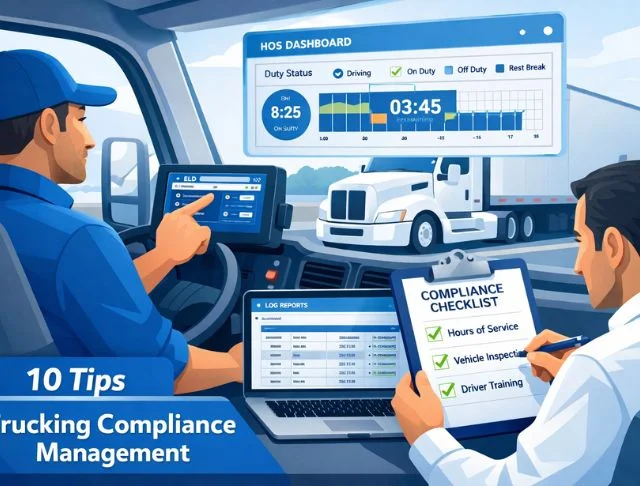
A driver logbook is a legally required document used to track a commercial driver’s working hours and duty status throughout the day. Drivers need to make this logbook to comply with the Federal Motor Carrier Safety Administration regulations and promote road safety and accountability. The main part of this system is the Record of Duty Status (RODS), which records a driver’s activities over a complete 24-hour period. The RODS divides time into four duty categories, which are off-duty, sleeper berth, driving, and on-duty but not driving. Drivers must update their status in 15 minutes to maintain precise and verifiable records.
Why Driver Logbooks Matter
Driver logbooks matter for several reasons, such as the following.
- It helps prevent fatigue-related accidents by ensuring drivers follow legal driving limits and take required rest breaks.
- Logbooks improve overall road safety by reducing the risks associated with driver exhaustion.
- These driver logbooks serve as legal documents that can be reviewed during inspections or accident investigations.
- It helps authorities verify compliance with Hours of Service (HOS) regulations.
- Logbooks protect drivers and carriers by providing proof of compliance with federal regulations.
- It reduces the risk of penalties, legal liability, and financial consequences caused by inaccurate or falsified records.
- Driver logbooks promote accountability and transparency in commercial driving operations.
Required Information in a Driver Logbook
A compliant driver logbook must include several important details, such as the driver’s name, date, and the complete 24-hour reporting period. Drivers must also record the carrier or company name, vehicle or truck identification number, total miles driven, and shipping or load information. These log details provide information about a specific vehicle, trip, and operation that will allow regulators to verify driving activity and distance traveled.
Drivers need to add their signatures to the logbook to confirm that all recorded information is accurate and truthful. These logbooks are considered legal documents, and the drivers’ signatures hold them accountable if entries are made incorrectly in the record.
Daily Documentation and Log Submission Rules
After recording accurate information, drivers need to follow strict documentation rules on a daily basis. They need to carry their current day’s log along with records from the previous seven days. It is recommended to carry these logbooks during roadside inspections, as enforcement officers may request these logs to verify compliance with Hours of Service regulations. Inspectors will carefully review the records to ensure all required fields are complete and properly maintained.
Drivers must also submit their logbooks to the carrier within 13 days. This allows companies to review records, identify compliance issues, and maintain proper documentation for regulatory purposes. In case drivers fail to maintain complete logs, miss entries, or are unable to present records during inspections, it will result in violations and penalties.
Understanding Hours of Service (HOS) Rules
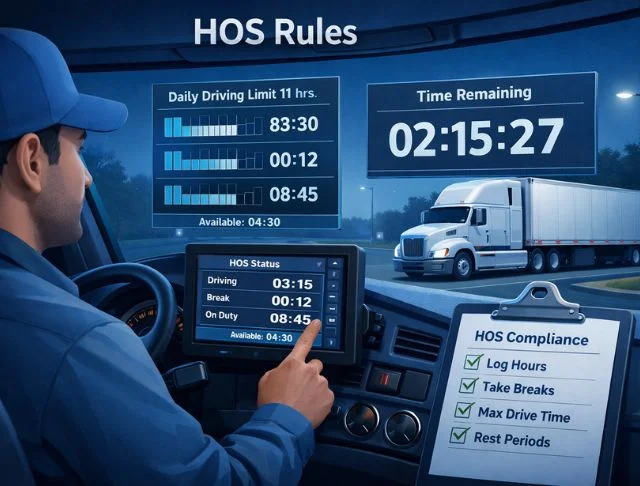
Hours of Service (HOS) rules are federally regulated safety standards established by the Federal Motor Carrier Safety Administration (FMCSA) to control the number of hours commercial motor vehicle drivers can drive, work, and remain on duty before taking mandatory rest periods. These regulations apply to most commercial drivers operating vehicles involved in interstate commerce and are enforced through driver logbooks, Electronic Logging Devices (ELDs), and Record of Duty Status (RODS) documentation.
The core Hours of Service (HOS) regulations that govern commercial driving operations are outlined below.
- Drivers may drive a maximum of 11 hours after taking 10 consecutive hours off duty.
- Drivers cannot drive beyond the 14 consecutive hour duty window after coming on duty.
- The 14-hour duty window includes all on-duty activities, including loading, unloading, fueling, paperwork, and vehicle inspections.
- Drivers must take a 30-minute break after 8 cumulative hours of driving.
- Drivers cannot exceed 60 hours on duty within 7 consecutive days.
- Drivers operating on an 8-day schedule cannot exceed 70 hours on duty within 8 consecutive days.
- Drivers who reach the 60/70-hour limit must stop driving until enough off-duty time is taken.
- Drivers may reset their weekly driving limits by taking at least 34 consecutive hours off duty under the 34-hour restart rule.
- HOS compliance must be recorded through driver logbooks or Electronic Logging Devices (ELDs).
- Drivers must maintain accurate Records of Duty Status (RODS) for all duty periods.
Exceptions and HOS Compliance
Drivers may extend their driving time by up to 2 hours when they face adverse driving conditions such as severe weather, road closures, or unexpected traffic delays, provided the situation is unforeseen and beyond their control. They can also use the short-haul exception if they operate within a limited radius and return to their starting location within the allowed time limits, which reduces some logging requirements.
Drivers operating under certain oilfield, agricultural, or construction-related exemptions may follow modified HOS rules depending on the nature of their work and location of operation. They are also exempt from standard HOS rules during emergency operations, such as disaster response, relief efforts, or government-declared emergencies. They can use a personal conveyance allowance when driving a commercial vehicle for personal, non-work-related purposes while off duty, without it counting toward driving time.
Electronic Logging Devices (ELDs)
Electronic Logging Devices (ELDs) are FMCSA-mandated systems that connect to a vehicle’s engine to automatically record a driver’s Hours of Service (HOS) and duty status, including driving, on-duty not driving, off-duty, and sleeper berth. They track real-time data such as engine hours, miles, ignition status, and vehicle movement, while storing records for compliance and inspections. ELDs are required for most interstate commercial drivers as they improve accuracy, prevent log falsification, and ensure adherence to HOS regulations like driving limits and duty windows.
Paper Logs and Backup Requirements
Paper logs are manual driver record books used to document a commercial driver’s Hours of Service (HOS) and duty status when Electronic Logging Devices (ELDs) are not available or cannot be used. Drivers use paper logs to record activities such as driving time, on-duty not driving, off-duty, and sleeper berth status in a written format instead of an electronic system.
Backup requirements refer to the rules drivers must follow when switching from ELDs to paper logs due to ELD malfunction or temporary unavailability. In such cases, drivers must accurately record all duty status changes, ensure entries are complete and timely, and continue using paper logs until the ELD is repaired or restored. Paper logs are also permitted for limited use, typically up to 8 days within a 30-day period, under specific regulatory allowances.
Drivers must fulfill the following requirements when using paper logs.
- Drivers must switch to paper logs when the ELD malfunctions or becomes unavailable.
- They must manually record Hours of Service (HOS) duty status without delay.
- They must log all duty status changes accurately (driving, on-duty not driving, off-duty, and sleeper berth).
- They need to make sure all entries are complete, legible, and properly maintained.
- Drivers need to carry and maintain current-day logs during the ELD downtime.
- Drivers must continue paper logging until the ELD is repaired, replaced, or restored.
- Drivers must retain backup paper records as part of compliance documentation for inspection.
- Drivers must ensure no gaps or missing time periods exist in the manual logs.
Logbook Exemptions and Record Responsibilities
Drivers operating within the 100 air-mile radius may be exempt from detailed logging if they return to their starting location within the required time limits. The 150 air-mile exemption also provides flexibility under specific conditions, while vehicles manufactured before the year 2000 are exempt from ELD requirements due to technical limitations.
Common Violations of Logbook Regulations
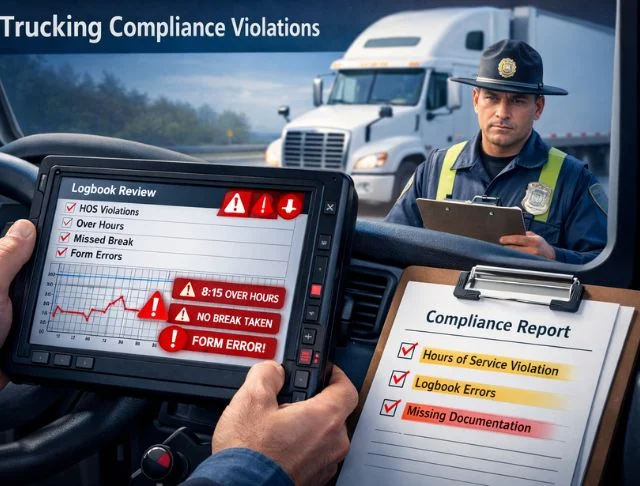
Drivers must avoid these common logbook violations to maintain compliance with Hours of Service (HOS) regulations and prevent penalties or enforcement actions.
- Exceeding Hours of Service (HOS) driving limits
- Violating the 14-hour duty window rule
- Missing mandatory rest breaks (such as the 30-minute break requirement)
- Incomplete or missing log entries
- Inaccurate recording of duty status (driving, on-duty, off-duty, sleeper berth)
- Failure to maintain continuous 24-hour log records
- Not carrying or presenting logs during roadside inspections
- Late submission of logbooks to the carrier
- Using paper logs improperly when ELD is required
- ELD misuse or tampering with electronic records
- Log falsification (intentionally altering or misreporting duty status information)
Legal and Financial Consequences of Violations
Drivers will face legal and financial consequences in case of logbook violations that include poor safety ratings, increased regulatory scrutiny, higher insurance costs, and potential loss of business opportunities. Legal and insurance investigations use logbooks as official evidence to determine compliance at the time of an incident. They help establish whether a driver was operating within legal limits, whether required rest breaks were taken, and whether fatigue contributed to an accident, making accurate recordkeeping critical in liability assessments.
Conclusion
Drivers and fleet operators must understand driver logbook rules, HOS regulations, and ELD requirements for safe and compliant commercial driving operations. These systems are actually designed for road safety and operational accountability. Drivers must also understand the exceptions, backup procedures like paper logs, and consequences of violations to protect themselves from costly penalties and legal risks.
Frequently Asked Questions
What is a driver logbook used for?
A driver logbook is used to track a commercial driver’s activities during each 24-hour period, including driving time, rest breaks, and off-duty hours. It’s a legal requirement that ensures drivers comply with federal safety regulations designed to prevent fatigue-related accidents. Think of it as a time diary that keeps both truckers and other road users safe by making sure drivers get adequate rest between shifts.
What is RODS in a logbook?
RODS (Record of Duty Status) is a daily log used by truck drivers to track their work and rest hours. It records four duty statuses: off-duty, sleeper berth, driving, and on-duty (not driving). This helps ensure drivers follow Hours of Service (HOS) regulations and stay compliant on the road.
Do drivers need to log off-duty time?
Yes, drivers are required to log their off-duty time as part of a complete 24-hour Record of Duty Status (RODS). This includes breaks, rest periods, and any time spent away from work duties. Keeping accurate off-duty records helps drivers stay compliant with Hours of Service (HOS) regulations and avoid violations during inspections.
What is the 11-hour driving rule?
The 11-hour driving rule allows commercial drivers to drive for up to 11 hours after taking at least 10 consecutive hours off duty. Once the 11-hour limit is reached, the driver must stop driving and complete the required rest period before getting back on the road. This rule is designed to reduce fatigue and improve road safety.
What is the 14-hour rule?
The 14-hour rule means a driver cannot drive after being on duty for 14 consecutive hours, even if they have not used their full 11 hours of driving time. The 14-hour window starts as soon as the driver begins work after a qualifying off-duty break. Once the limit is reached, the driver must take the required off-duty time before driving again.
When is a 30-minute break required?
A 30-minute break is required after a driver has completed 8 cumulative hours of driving time without a qualifying interruption. The break can be taken as off-duty, in a sleeper berth, or as on-duty not driving time. This rule helps reduce driver fatigue and supports safer driving on the road.