

by Muhammad Zubair
May 12, 2026

Reviewed by Ford
Truck Dispatch Specialist
Truck drivers and carriers lose several hours every year because of high dwell time at warehouses, distribution centers, ports, and shipping facilities. Long truck wait times not only reduce driver earnings and fleet productivity but also increase detention fees, fuel costs, delayed deliveries, and supply chain disruptions. These trucks remain stuck at docks because of poor scheduling, dock congestion, paperwork delays, or inefficient loading operations. This results in loss of carriers losing revenue and drivers facing frustration, burnout, and reduced Hours of Service (HOS) availability.
However, you can protect your trucks and facilities from such problems by understanding dwell time. In this guide, you will learn what dwell time means, how it works, common causes behind excessive truck delays, how to calculate dwell time, and the best strategies and technologies used to reduce dwell time in modern trucking operations.
What Does Dwell Time Mean?

Dwell time in trucking refers to the amount of time a truck remains free or idle at a shipping facility, warehouse, distribution center, port, or customer location before leaving the starting point. You can consider it the total time that a truck will wait at a facility from arrival to departure.
Truck owners and operators need to understand dwell time, as in logistics operations, it is considered a critical performance metric because long waiting periods reduce transportation efficiency, increase operational costs, and disrupt supply chain movement. Moreover, it affects the overall earnings as trucks generate revenue only while moving freight, not when they are parked or waiting.
As a truck driver, you may face dwell time in the following forms.
- Waiting for a dock assignment
- Completing warehouse check-in procedures
- Loading or unloading freight
- Waiting for paperwork approval
- Sitting in a yard before gate-out clearance
When Does Dwell Time Start and End?
Truck dwell time measures the total time that usually starts when the truck enters the facility gate (gate-in) and ends when the truck exits the facility (gate-out). The standard dwell time calculation includes arrival at the facility, gate-in registration, check-in, paperwork processing, and waiting for dock availability. You will also need to add time required during freight loading or unloading, final documentation, and gate-out departure.
Dwell Time vs Detention Time
You may confuse dwell time with detention time, but both terms are different. Dwell time is the truck’s total stay at a facility, while detention time is the extra waiting period that is chargeable after the free waiting limit ends. It will be easier to understand for you through the following comparison table.
| Factor | Dwell Time | Detention Time |
| Meaning | Total truck stay at the facility | Billable waiting time after free period |
| Starts | At the gate on arrival | After the free waiting time expires |
| Ends | At gate-out departure | When loading/unloading finishes |
| Purpose | Operational KPI | Carrier compensation metric |
| Cost Impact | May or may not involve fees | Usually results in detention charges |
In most carrier agreements, shippers allow approximately two hours of free waiting time before detention charges begin. Once the free dwell period expires, detention time starts accumulating. Excess dwell time triggers detention charges because carriers lose productive driving hours while trucks remain idle.
For example:
- Truck arrives at 8:00 AM
- Free waiting allowance = 2 hours
- Loading completes at 12:00 PM
Total dwell time = 4 hours
Detention time = 2 hours
How Dwell Time Works in Trucking
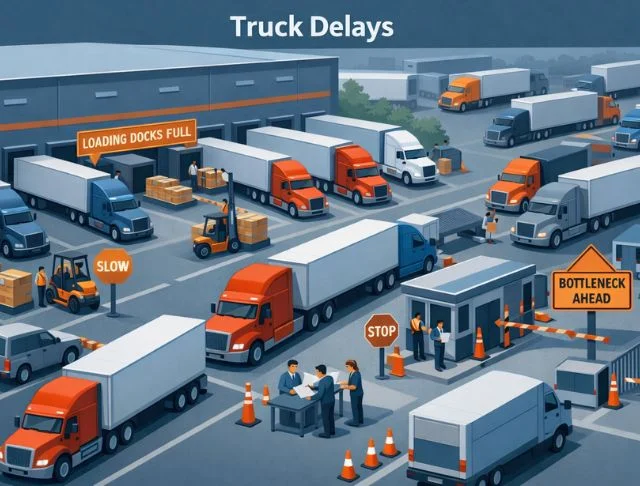
Dwell time works by measuring the total amount of time a truck spends at a facility from gate-in arrival to gate-out departure. It is the time when trucks may wait for dock assignments, complete check-in procedures, move through the yard, or undergo loading and unloading operations.
Several operational factors can increase or decrease dwell duration, which includes loading delays, dock congestion, paperwork processing, labor shortages, and freight complexity. At the same time, if there are slow loading or unloading processes, it can also keep trucks parked at docks for extended periods, especially when warehouses handle mixed pallet loads or manually verify inventory.
Many facilities monitor these delays by using gate-in and gate-out tracking systems that record arrival times, dock activity, loading duration, departure times, and driver wait periods. You can use this data to identify bottlenecks, improve appointment scheduling, and optimize turnaround efficiency.
Loading and Unloading Delays
Loading delays are the first factor that increases dwell time in trucking operations. When warehouse staff cannot load or unload freight efficiently, trucks remain parked at docks for extended periods. Some of the most common operational issues that result in loading and unloading delays are given below.
- Late freight preparation
- Slow forklift operations
- Incorrect pallet arrangement
- Manual inventory verification
- Labor shortages
- Damaged freight handling
In most cases, mixed pallet loads and complex freight configurations often increase unloading duration because workers require additional sorting and handling time.
Gate-In and Gate-Out Tracking
Many modern facilities have tried to reduce this dwell time through different techniques, such as the installation of gate-in and gate-out tracking systems to monitor truck movement and measure dwell duration accurately. These gate-in and gate-out tracking systems capture the following things.
- Arrival timestamps
- Dock assignment timing
- Loading/unloading duration
- Departure timestamps
- Driver wait periods
Transportation managers use this data to identify causes behind delays, compare facility performance, and optimize turnaround efficiency. With the help of this tracking system, facilities can reduce check-in delays, improve appointment coordination, minimize congestion, and increase warehouse throughput.
Common Causes of High Dwell Time
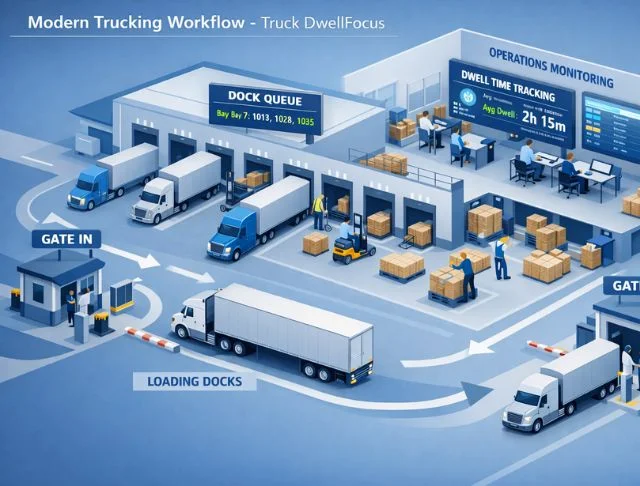
Truck drivers or owners may face high dwell time due to different causes, such as poor appointment scheduling, dock congestion, paperwork delays, warehouse understaffing, and complex freight handling requirements. Several facilities have limited dock capacity, and when multiple trucks arrive simultaneously, trucks need to wait in long queues.
There may be administrative issues, such as manual paperwork verification, security checks, and slow gate processing, which also increase truck wait times and detention risk. Several cases, such as mixed pallet loads, fragile freight, and multi-stop shipments, need extra handling time, which keeps trucks at the dock longer and reduces warehouse efficiency.
Poor Appointment Scheduling
Poor appointment scheduling is the basic reason behind dwell duration because multiple trucks arrive simultaneously, creating dock bottlenecks and long waiting queues. It occurs when facilities overbook appointments, delivery windows overlap, carriers arrive late, and dock capacity is limited. This cause of dwell time is handled through efficient dock scheduling, which helps distribute truck arrivals evenly throughout the day and reduces congestion.
Dock Congestion
Dock congestion causes truck waiting periods when too many vehicles compete for limited loading bays. It is a result of slow warehouse operations, insufficient dock doors, delayed outbound freight, and uncoordinated scheduling.
Documentation and Check-In Delays
Complex check-in procedures extend truck wait time significantly. Truck drivers waste time because of manual paperwork verification, missing shipping documents, security checks, incorrect BOL information, and Slow gate processing. You can reduce dwell time due to operational delays through digital paperwork systems and automated check-in kiosks.
Understaffed Warehouses
Warehouse understaffing causes loading delays because there are not enough workers available to handle freight efficiently. The shortage of labor disturbs the Forklift operations, dock management, inventory verification, and trailer loading speed.
Complex or Mixed Loads
Mixed pallet loads increase unloading duration because warehouse workers must sort, separate, and verify multiple product categories. These complex loads require multiple SKUs, temperature-sensitive freight, fragile goods, special handling requirements, and multi-stop deliveries. The more complicated the freight structure becomes, the longer trucks remain at the dock.
Why Dwell Time Is a Problem in Trucking
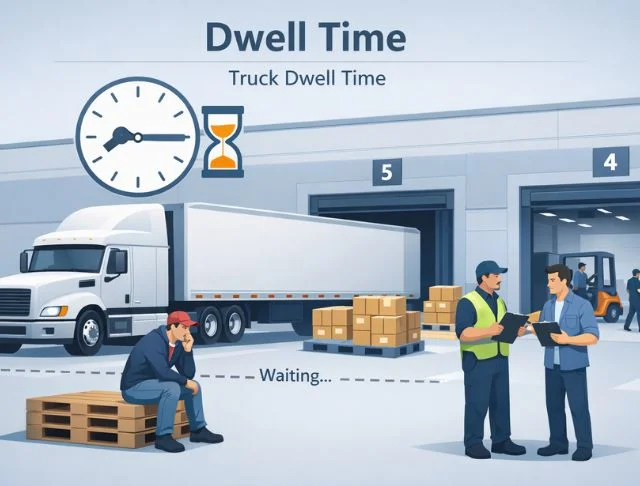
Dwell time is a problem in trucking, as it reduces driver productivity, increases operational costs, and disrupts supply chain efficiency. Drivers lose valuable driving hours, fleets complete fewer deliveries, and carriers face higher detention fees, fuel costs, and reduced profitability during this time. When drivers face excessive dwell time, they may also face missed appointments, inventory shortages, delayed shipments, and weakened transportation reliability.
Driver Idle Time and Lost Productivity
Truck drivers lose productive driving hours due to this dwell time at facilities. Drivers are paid per mile, and when they are not traveling, it wastes their earnings. Along with this, long idle periods also lower fleet utilization, reduce daily delivery capacity, increase schedule disruptions, and delay future pickups.
Increased Detention Fees and Freight Costs
Long dwell time increases freight costs because carriers charge detention fees to compensate for lost time. They may charge from $50 to $100 per hour for standard freight and even higher rates for specialized equipment.
Supply Chain Delays
High dwell time reduces supply chain efficiency across the logistics network. One delayed truck can create ripple effects such as missed delivery appointments, inventory shortages, manufacturing disruptions, and delayed retail replenishment.
Driver Burnout and Safety Risks
Long dwell times contribute to driver frustration, stress, and burnout that can result in speeding, skipping breaks, driving aggressively, and rushing deliveries.
How to Calculate Dwell Time
Dwell time is calculated by subtracting the truck’s gate-in arrival time from its gate-out departure time. In simple terms, it measures the total amount of time a truck spends at a facility during loading, unloading, check-in, and waiting processes. For example, if a truck enters at 9:00 AM and exits at 1:30 PM, the total dwell time is 4 hours and 30 minutes.
Average dwell time benchmarks vary by facility type and freight operation.
| Facility Type | Average Dwell Time |
| Standard warehouse | 1–3 hours |
| Distribution center | 2–4 hours |
| Ports and terminals | 4–8+ hours |
| Grocery distribution | 3–6 hours |
How to Reduce Dwell Time in Trucking
Every driver and facility wants to reduce dwell time, as it reduces the overall efficiency of not only trucks but also of the respective facility. If you are also facing the same problem, you can reduce dwell time by improving scheduling accuracy, streamlining facility operations, and using logistics technology to minimize delays. Companies that optimize dock coordination, automate paperwork, and improve freight preparation often experience faster truck turnaround times, lower detention costs, and better warehouse throughput. Many carriers and shippers also use real-time visibility systems and operational strategies to reduce driver idle time and improve overall supply chain efficiency.
Common ways to reduce dwell time include the following.
- Improve dock scheduling
- Use real-time visibility software
- Implement drop-trailer programs
- Streamline check-in and paperwork
- Use pre-staged freight
- Automate gate entry systems
- Improve warehouse staffing
- Optimize dock and yard management
- Use appointment-based scheduling
Technology Used to Reduce Dwell Time
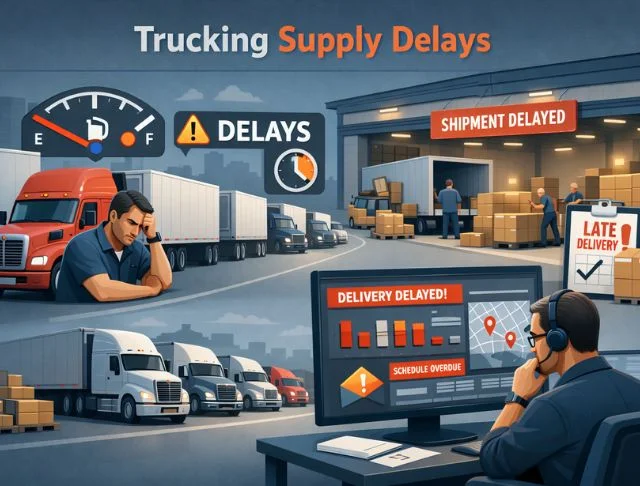
Long truck queues, dock congestion, poor communication, and inefficient scheduling are some of the biggest causes of excessive dwell time in trucking operations. To solve these issues, logistics companies use technologies that improve shipment visibility, automate scheduling, optimize yard movement, and reduce operational delays across warehouses and transportation networks.
Common technologies used to reduce dwell time in trucking include the following.
- Transportation Management Systems (TMS)
- Yard Management Systems (YMS)
- Real-time visibility software
- Predictive analytics platforms
- AI-powered scheduling systems
- Automated dock scheduling software
- Electronic bills of lading (eBOL) systems
- Digital check-in and gate automation systems
- GPS fleet tracking systems
- Warehouse Management Systems (WMS)
- RFID and trailer tracking technology
- Dock and yard visibility platforms
- Appointment scheduling software
- Telematics and fleet monitoring systems
Conclusion
Dwell time is a very important performance metric in trucking, which is important for drivers, owners, and facilities. You should always try to reduce this, as it affects driver productivity, freight costs, warehouse efficiency, and overall supply chain performance. We will recommend using the latest technologies, such as TMS, YMS, and real-time visibility tools for minimizing delays and improving turnaround times.
Frequently Asked Questions
What Is Considered Excessive Dwell Time?
Trucking companies consider dwell time excessive when trucks need to wait beyond the standard two-hour free period allowed in carrier agreements.
How Long Is Free Waiting Time?
The free waiting time is only two hours, after which truck owners will start charging.
What Causes Long Truck Wait Times?
Long truck wait times are caused by a number of factors, such as dock congestion, poor appointment scheduling, warehouse understaffing, paperwork delays, freight complexity, and slow loading operations.
How Does Dwell Time Affect Freight Rates?
Extended dwell increases freight costs because of higher detention fees, increased shipping rates, and reduced carrier availability.
How Can Carriers Avoid Detention Fees?
Carriers can reduce detention fees through different ways, such as arriving on time, using appointment scheduling systems, communicating delays early, working with efficient facilities, leveraging drop trailer programs, and using real-time visibility tools.