

by Faizan Hassan
Feb 5, 2026

Reviewed by Ford
Truck Dispatch Specialist
A flatbed truck driver plays a necessary role in the trucking industry. Every driver must meet certain requirements to obtain a flatbed truck license. Because flatbed trucks carry heavy loads, they require significant experience to load and unload on long routes.
Driving a flatbed truck is challenging due to the equipment and responsibilities involved, which require essential documents and expertise. We’ll explore the important information about flatbed trucks and CDL requirements.
Understanding flatbed truck requirements is essential for owner-operators and drivers because compliance with regulations must be maintained consistently.
- What Is a Flatbed Truck?
- Do You Need a CDL to Drive a Flatbed Truck?
- Flatbed Truck License Classes Explained
- Flatbed Truck Weight Limits That Affect License Requirements
- Endorsements Required for Flatbed Truck Drivers
- Federal vs State Flatbed Truck License Requirements
- Additional Requirements to Drive a Flatbed Truck
- Common Flatbed Truck Licensing Mistakes to Avoid
- Max Dispatch Service for Flatbed Owner-operators
What Is a Flatbed Truck?
A flatbed truck is an open trailer truck designed to load heavy cargo. A flatbed truck can load and transport cargo that is difficult to fit in enclosed trailers. Flatbed trucks are efficient for loading industrial materials and oversized equipment.
In a flatbed, the load is exposed, and drivers must remain highly attentive while loading. Because the trailer is open, the load needs to be secured properly with chains and straps.
Several types of flatbed trucks vary by size and weight, which makes proper driver licensing necessary before operation. Complying with federal regulations can give you peace of mind.
Do You Need a CDL to Drive a Flatbed Truck?
Flatbed trucks come in various types, and each type is determined by size and weight. Many flatbed trucks fall under federal CDL regulations, but smaller flatbed trucks may operate without CDL requirements.
When a CDL Is Required for Flatbed Trucks
Federal regulations have some requirements for the CDL based on truck weights. A CDL is required if a flatbed truck with a trailer has a gross weight of 26,000 pounds, or if the truck and trailer exceed 10,000 pounds.
Flatbed trucks that operate interstate or across state lines for commercial operations meet these criteria. CDL requirements become mandatory under federal law for these operations.
When a CDL Is Not Required for Flatbed Trucks
Some flatbeds do not require a CDL when they’re not hauling heavy trailers or operating interstate. Some small flatbed trucks with a gross weight of 26,001 pounds or less may be driven with a standard license.
Certain agricultural uses and limited-distance operations may be allowed without a CDL. These are the conditions under which a CDL is not required for flatbed trucks.
Flatbed Truck License Classes Explained
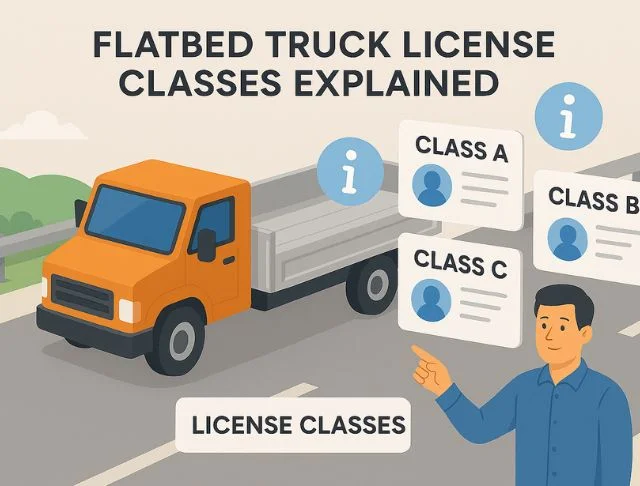
Depending on the size and weight of flatbed trucks, they fall under different CDL classes. Understanding flatbed truck license classes can help drivers avoid violations and obtain the correct license.
Class A CDL for Flatbed Trucks
A Class A CDL is required for a vehicle with a gross combination weight of 26,001 pounds or more. It includes a towed vehicle weighing 10,000 pounds or more. This is the most common license for flatbed drivers.
A Class A CDL allows one to legally haul heavy weights and oversized loads across multiple states. Having a Class A license may qualify a driver to operate some Class B and C vehicles.
Class B CDL for Flatbed Trucks
A Class B CDL is required for a vehicle with a gross combination weight of 26,001 pounds or more, or for a vehicle towing another vehicle weighing up to 10,000 pounds.
Many straight flatbed trucks fall under this CDL class and are commonly used for local construction deliveries. Class B CDL drivers have fewer privileges than Class A drivers, but the license is still suitable for many flatbed operations.
Class C License and Flatbed Trucks
A Class C CDL is uncommon for flatbed trucks. A Class C license comes under the CDL weight requirements and is for those transporting hazardous materials in small quantities.
A driver needs a Class C CDL to operate a vehicle that doesn’t meet the criteria of a Class A or Class B vehicle.
Flatbed Truck Weight Limits That Affect License Requirements
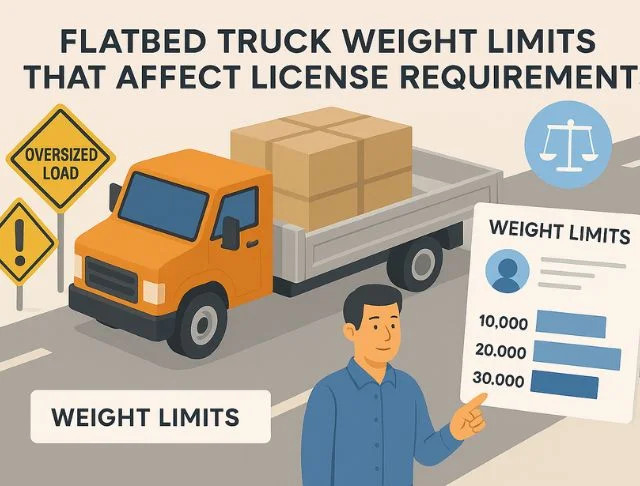
Weight limits of vehicles depend on the class of license and the requirements.
Gross Vehicle Weight Rating (GVWR)
GVWR counts the weight of the whole vehicle, including cargo, fuel, and passengers. When a flatbed truck’s GVWR reaches 26,001 pounds or more, federal regulations require a CDL for the driver.
Many heavy and medium flatbed trucks exceed this weight limit, which places them under federal CDL regulations.
Gross Combination Weight Rating (GCWR)
GCWR applies when a trailer is towed with the truck. It shows the weight of the truck, cargo, and the towing trailer combined. If the GCWR is 26,001 pounds or more and the trailer weighs 10,000 pounds or more, a Class A CDL is required.
Endorsements Required for Flatbed Truck Drivers
There is no specific endorsement required for a flatbed truck. Many trucks may need additional qualifications for hauling heavy loads or hazardous materials. Drivers must have a HazMat endorsement, which includes background checks and testing.
Many oversized and overweight flatbed trucks require a special permit before transporting, rather than an endorsement requirement. Many carriers require security training due to heavy loads, but no additional endorsement is legally required.
Federal vs State Flatbed Truck License Requirements
A CDL for flatbed truck operation is required for both federal and state operations. The truck owner must know the rules that apply to their specific operations.
Federal CDL Requirements (FMCSA)
The FMCSA establishes the rules nationwide to create consistency and improve safety across the trucking industry. The FMCSA requires the following standards:
- Minimum age requirement
- Medical certification
- Training rules implementation
- Drug and alcohol tests
Flatbed trucks that operate interstate must meet all FMCSA regulations before transporting cargo.
State-Specific CDL Rules
Some states may impose additional requirements on flatbed truck operations. These can include varying age requirements, testing procedures, and specific restrictions. State rules apply only within state lines.
Some states may allow farm vehicles and short-distance hauling, but drivers should consult their DMV.
Additional Requirements to Drive a Flatbed Truck
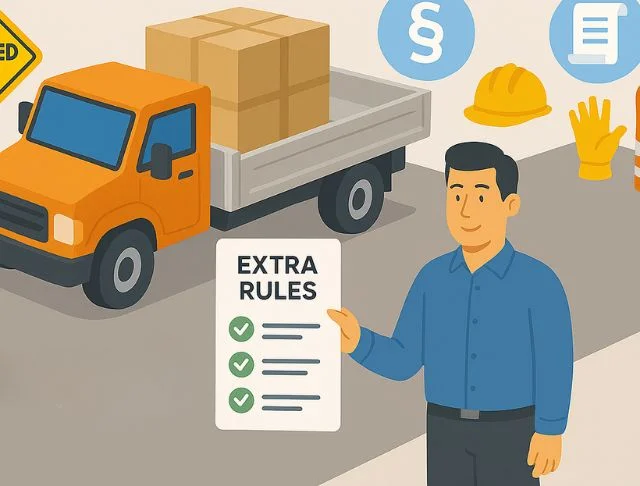
Having a license may not be enough for flatbed truck drivers. They must meet additional legal requirements to operate.
DOT Medical Card Requirements
Flatbed drivers have to pass a DOT physical exam, which is conducted by a certified medical examiner. A medical card confirms that the driver is physically fit to drive and operate a commercial vehicle.
Entry-Level Driver Training (ELDT)
If anyone wants to operate a flatbed truck, they must have entry-level driver training through an FMCSA provider. ELDT covers essential knowledge and training related to truck operation and safety precautions.
Drug and Alcohol Testing Rules
The drivers who are operating flatbed trucks are subject to federal drug and alcohol testing regulations. It includes alcohol testing at various times, including pre-employment, random testing, and return-to-duty testing after an accident.
Common Flatbed Truck Licensing Mistakes to Avoid
Many drivers face violations due to a misunderstanding of flatbed truck licensing rules. Common mistakes include the following:
- Miscalculate the vehicle weight rating
- Driving with the wrong CDL class
- Ignoring federal or state CDL requirements
- Failing to maintain a valid DOT medical card
Max Dispatch Service for Flatbed Owner-operators
Max Dispatch Service supports flatbed truck drivers in staying compliant while maintaining consistent loads. We ensure loads match license requirements and weight ratings, with experienced dispatchers who understand flatbed regulations.
We help owner-operators focus on driving and growing their business while staying compliant with federal and state regulations.