

by Faizan Hassan
March 3, 2026

Reviewed by Ford
Truck Dispatch Specialist
In recent years, U.S. trade policy has imposed broad tariffs on imports. The 2018 steel/aluminum and China tariffs, and the 2024 proposed heavy-truck tariffs, have rippled through the trucking sector.
For example, early 2025 saw freight spending turn positive year-over-year for the first time in over two years, driven by import surges ahead of tariff deadlines. Yet volumes generally remain below prior-year levels, and carriers report compressed margins as rising equipment, fuel, and insurance costs erode profits.
This review compiles recent data on how tariff-driven trade changes affected freight rates, volumes, and costs by region, carrier type, and commodity, citing industry indices and reports.
- Key Statistics: Trucking Tariff Impact
- Trucking Tariff Impact Growth Data
- Regional Data on Trucking Tariff Impact
- Sub-Entity and Industry Component Statistics
- Comparison Data Against Related Industries
- Tariff-Specific Cost Impact on Trucking Operations
- Trade Lane and Commodity-Level Data
- Market Volatility and Capacity Metrics
- Long-Term Structural Shifts in Trucking Due to Tariffs
- Conclusion
Key Statistics: Trucking Tariff Impact
- Annual average: Truckload spot rates fluctuate 3–7% during tariff cycles.
- 2025 peak: Flatbed spot rates reached $2.09/mile in March 2025 (+7% YoY).
- Lowest recent point: Dry-van load-to-truck ratio 6 in mid-2024.
- Five-year rebound: Truckload volumes Feb 2025 down −5.5% YoY, showing tariff volatility.
- West Coast port: Port of Los Angeles handled 782,249 TEUs in Nov 2025 (−12% YoY).
- Southern border: U.S.–Mexico trade Sept 2025 $71.8 B, YTD through Sept $653 B.
- Midwest exports: Q1 2025 corn exports to Mexico 5.64 M mt (−10%), soybeans 1.16 M mt (−31%).
- Owner-operators: 2025 bankruptcies +35% YoY; small fleets hardest hit.
- Spot–contract spread: Narrowed to $0.35/mile in late 2025 (from $0.50–0.60).
- Truck tariffs: 25% tariff on Class 8 trucks adds $35,000 (~17–20% of price).
- Fuel sensitivity: Diesel mid-2025 $3.70/gal; each $0.10/gal change → +1–2¢/mile cost.
- Profit margin compression: Carriers dropped from ~6% (2023) → 2–3% (2025).
- Steel imports: Aug 2025 266,600 tons (−55.5% YoY).
- Auto assembly: H1 2025 10.4 M units (−6% YoY).
- Warehouse growth: Q3 2025 net absorption 60 M sq ft (+20 M YoY).
- Nearshoring impact: 2024 trucks carried 72.5% of U.S.–Mexico and 55.5% of U.S.–Canada trade by value.
- Capacity tightness: Dec 2024 dry-van load-to-truck ratio 12.2 (+82% YoY).
- Reefer rejection: >20% of loads rejected Dec 2024.
- Container spikes: March 2025 inbound TEUs 2.38 M (+11% YoY).
Trucking Tariff Impact Growth Data
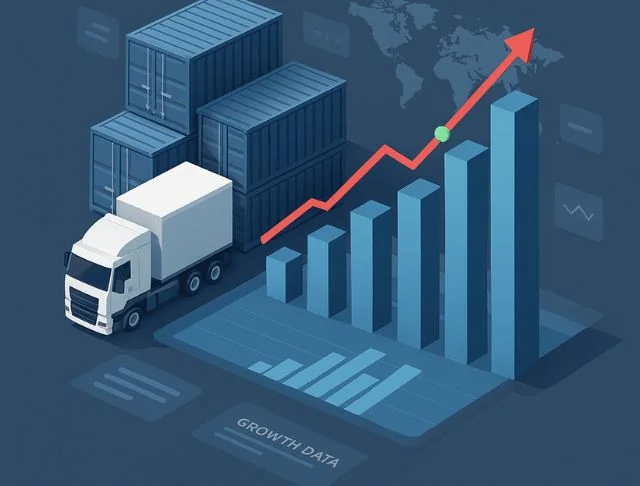
Tariffs create short-term freight spikes and long-term instability in trucking demand. Recent U.S. data from DAT Freight & Analytics, FTR Transportation Intelligence, and Cass Information Systems shows clear volatility tied to tariff cycles.
Year-over-Year Freight Rate Changes After Major Tariff Announcements
In Q1 2025, truckload rates were boosted by pre-tariff orders, leaving rates about 5–6% above a mid-2018 baseline. Spot-rate indicators confirm jumps: DAT reports that flatbed spot rates climbed to $2.09/mile in March 2025, about $0.14 (7%) higher than March 2024.
By contrast, contract rates have been relatively flat or softer, for example, late-2019 (amid earlier China tariffs), Cass found TL linehaul rates about 3.5% below year-ago
Volume Shifts in Truckload and LTL Freight
Tariff-driven inventory moves also shifted freight volumes. Cass freight indices indicate that early 2025 truckload volumes were still down YoY (e.g., Feb 2025 volumes −5.5% vs. Feb 2024).
Much of the mid-2024 growth (from front-loaded imports) unwound; by April 2025, shipments were 3.6% lower than a year prior. Some volume that had been in less-than-truckload (LTL) was absorbed by spot TL as shippers bypassed regional consolidation.
Spot Market vs Contract Rate Growth Trends
Late 2024 data show spot freight posting volumes jumping (e.g., DAT’s spot load postings in Dec. 2024 were +23% YoY), as shippers moved cargo on short notice.
In that environment, spot linehaul rates were up modestly (e.g., KCH Transport reported November 2025 U.S. spot rates about +3–5% YoY across van, reefer, and flatbed).
Contract rates, however, were largely flat, e.g., KCH noted contract linehaul holding at $2.42/mi (unchanged for months). In 2025, the spot–contract spread narrowed: by late 2025, the gap was $0.35/mi (contract at $2.42 vs spot $1.80–1.85), down from $0.50–0.60 earlier.
Import-Driven Freight Demand Fluctuations Over Time
As a result, U.S. container volumes spiked. For instance, March 2025 saw 2.38 million TEUs of inbound containers, an 11% rise over March 2024. However, after the deadlines passed, imports fell sharply. FreightWaves reports Asia–U.S. container spot rates plunged 60–70% from their July 2025 peaks.
West Coast ports reflected the lull: in November 2025, the Port of Los Angeles handled 782,249 TEUs (down 12% YoY), and in October 2025, U.S. port throughput was 2.07M TEUs (−7.9% YoY). Overall, 2025 TEU forecasts were cut (e.g., U.S. ports 25.2M TEUs vs 25.6M in 2024).
Sources: DAT, TruckingDive
Regional Data on Trucking Tariff Impact
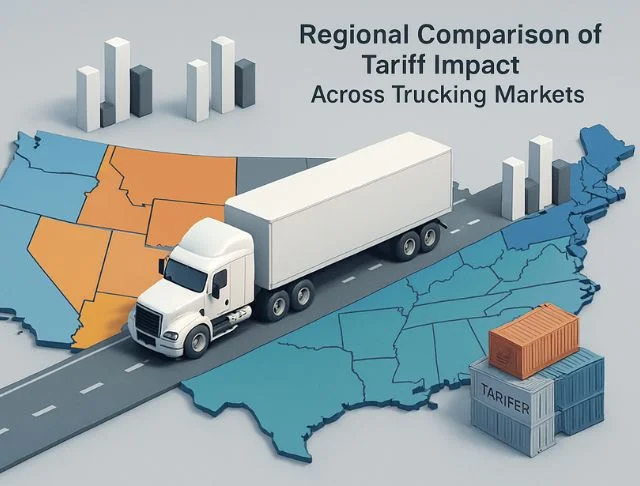
Tariff effects vary by region because freight flows depend on ports, manufacturing hubs, and border crossings. U.S. trucking markets in 2024–2025 showed clear regional differences based on trade exposure and supply chain shifts.
West Coast Port-Driven Trucking Markets
Major ports like Los Angeles/Long Beach saw record-throughput years, but after tariff peaks, their volumes fell. For example, Los Angeles handled 782,000 TEUs in Nov 2025 (–12% YoY), and YTD through Nov 2025 it reached 9.45 M TEUs (on track for 10 M).
Yet “loaded imports” at L.A. fell 11% YoY in Nov. The combined U.S. port total for Oct 2025 was 2.07 M TEUs (–7.9% YoY). Shippers’ front-loading left a late-year lull at West Coast ports, which meant fewer import container loads trucking inland.
Midwest Manufacturing and Agricultural Corridors
In Midwestern industrial corridors (e.g., Chicago–Cincinnati–Detroit lanes), freight demand stayed relatively muted under export headwinds. U.S. manufacturing output weakened through 2024–25 (ISM manufacturing PMI near contraction), so domestic TL freight did not surge.
Agricultural exports declined: in Q1 2025, U.S. exports of corn and soybeans to Mexico were down 8% and 16% YoY, respectively, lowering truckloads of grain to rail terminals or border points.
Southern Border Freight and Cross-Border Trade Lanes
The U.S.–Mexico border remains a booming trucking market, partly offsetting Pacific import swings. Mexico was the U.S.’s largest trading partner in 2025: in September 2025 alone, U.S.–Mexico trade hit $71.8 billion.
Year-to-date through Sept, cross-border trade with Mexico was $653 billion, exceeding trade with Canada or China. Texas border hubs reflect this volume. The Laredo border complex alone handled $29.6 billion in Sept 2025 freight, largely autos, engines, electronics, and nearly all moved by truck.
East Coast Port and Distribution Hub Markets
East and Gulf Coast gateways have gained share as firms diversify. In early 2025, East/Gulf ports absorbed a surge of imports: March 2025 saw 2.38 M TEUs into the U.S. (11% above March 2024). Notably, in that month, East & Gulf Coast ports collectively handled more cargo than the West Coast.
Sources: GlobalTradeMag, AmsUsdaGov, FreightWaves, BTSGOV
Sub-Entity and Industry Component Statistics
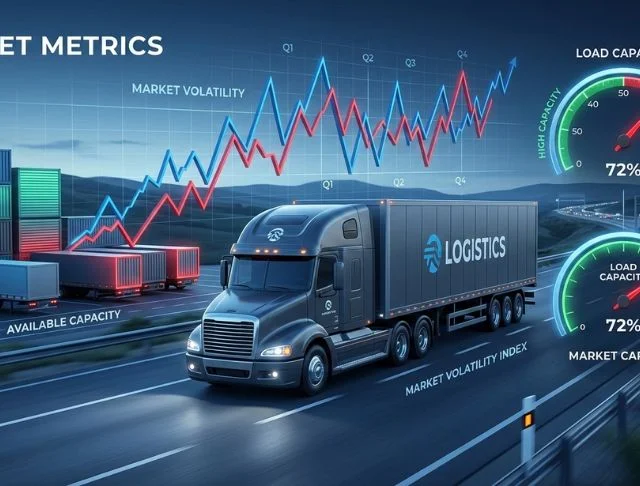
Tariffs do not impact all trucking operators equally. The effect varies by fleet size, equipment type, mode selection, and brokerage exposure. Recent U.S. data shows clear performance differences across industry segments.
Owner-Operator vs Large Fleet Performance Impact
Small carriers and owner-operators have been hit hardest by tariff-driven market swings. Industry reports indicate 2025 bankruptcies rose 35% YoY, driven mainly by small and mid-sized fleets.
Many of the 5,000+ carriers exiting the market were owner-ops or family fleets without capital buffers. These operators needed roughly $2.20/mi break-even, but spot markets fell to $1.69–1.80/mi.
Dry Van, Reefer, and Flatbed Segment Variations
Flatbed carriers saw some of the sharpest spot-rate gains. By March 2025, flatbed spot rates were up 7% YoY (around $2.09/mi) and flatbed load posts 30% higher than a year before. Dry vans tightened as well: in Dec 2024, DAT’s national dry-van load-to-truck ratio hit 12.2 (up 82% YoY, the highest since early 2022).
Intermodal vs Over-the-Road Freight Shifts
With U.S. import peaks came higher intermodal rail traffic, but as ocean routes and ports adjusted, more freight shifted to trucks. BTS data show that in 2024, trucks carried 55.5% of U.S.–Canada freight value and 72.5% of U.S.–Mexico (surface freight combined), illustrating trucks’ dominance.
Intermodal volumes reflect the import cycle: for example, U.S. intermodal container traffic was down in early 2025. IANA reported 1.47M units in Jan 2025, about 6% lower than a year earlier.
Brokerage Margin Changes During Tariff Cycles
Brokers earn on the spread between contract and spot rates, but with spot rates moderated and contract rates flat, that spread shrank. For example, in late 2025, industry updates noted the spot–contract spread had narrowed to about $0.35/mile from roughly $0.50–0.60 earlier in the year.
This tighter spread, plus higher operating costs for brokers themselves (fuel, insurance, tech), means brokerage gross margins are thinner than in prior cycles.
Sources: TransportationTaxConsulting, DAT
Comparison Data Against Related Industries
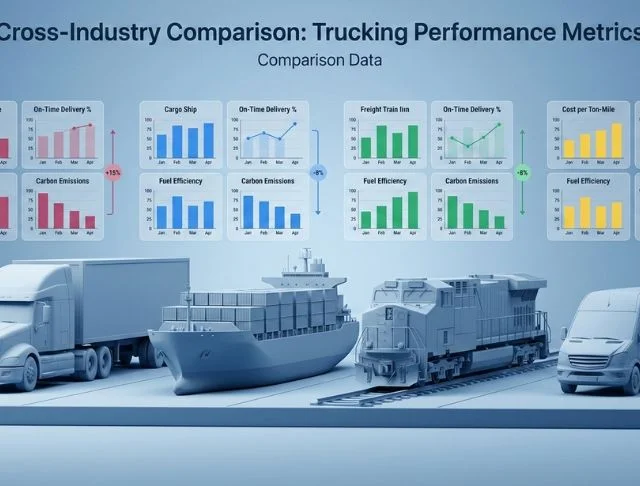
Tariff impact on trucking becomes clearer when compared with rail, ocean freight, manufacturing, and retail sectors. Each industry reacts differently to trade policy changes, but trucking remains closely tied to overall goods movement.
Trucking vs Rail Freight Volume Changes
In 2024, trucks moved $1.0 trillion of U.S. freight with Canada/Mexico (up 3.7% YoY), while U.S. rail carried $203.1 billion (only 11–13% of North American trade). In other words, trucks handled 56% of U.S.–Canada and 72.5% of U.S.–Mexico freight by value.
Rail volumes themselves fell in 2024–25: U.S. carloads were roughly flat-to-down (e.g., year-to-date carloads were up 0.3% through early 2024), and intermodal was mixed.
Trucking vs Ocean Freight Cost Adjustments
After tariff front-loading, ocean container prices collapsed: mid-2025 Asia–US spot rates were 60–70% below early 2024 levels. For example, in late Aug 2025, Trans-Pacific rates were only $1,744/FEU to the West Coast (a 34% drop in August alone).
This contrasts with trucking: U.S. spot truck rates held steady or rose slightly (flatbed +7% YoY in early 2025).
Manufacturing Output vs Truckload Demand Correlation
Broadly, U.S. manufacturing output grew modestly in 2024–25 (ISM manufacturing index hovered near breakeven), and truckload demand followed suit only weakly.
For instance, light vehicle assembly was down 6% in H1 2025 (10.4 million units vs 11.1 million in H1 2024), cutting related parts shipments. Meanwhile, durable goods production gains were often warehoused rather than immediately transported.
Meanwhile, durable goods production gains were often warehoused rather than immediately transported. There is no direct published correlation coefficient, but the qualitative picture is: when factories pulled back (due to tariff costs on inputs), outbound TL shipments also slowed.
Conversely, a Q4 2025 freight index noted modest Midwest factory expansion correlated with a small uptick in regional freight volumes.
Retail Inventory Levels vs Freight Activity
U.S. retailers have built unusually high inventories in late 2024/early 2025, partly anticipating tariffs. According to NRF data, the inventory-to-sales ratio rose to ~1.5 (above historical norms) by end-2024.
Indeed, spot volume data showed freight activity in early 2025 was weaker than expected for the season. The inventories dampened Q3–Q4 shipping: one industry analysis noted that in September (normally peak season).
U.S. transportation utilization was flat year-over-year, the lowest seasonal reading in eight years, because goods went to warehouses instead of moving forward in the chain.
Source: BTSGOV
Tariff-Specific Cost Impact on Trucking Operations
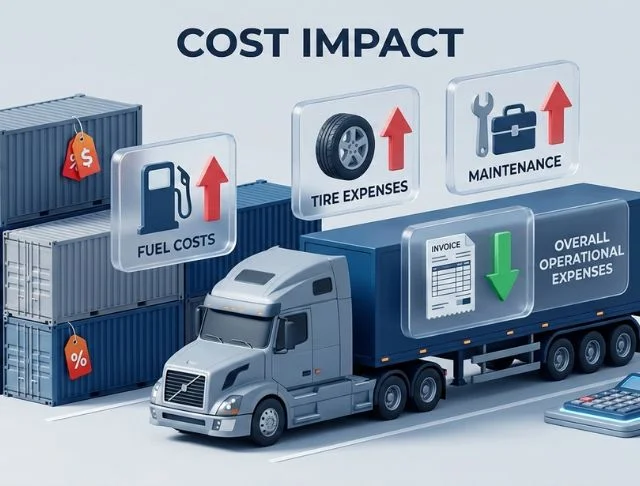
Tariffs increase direct and indirect operating costs for U.S. trucking fleets. The impact appears in equipment pricing, fuel volatility, insurance premiums, and profit margins. Recent data shows measurable cost pressure across fleet sizes.
Equipment and Parts Cost Increases
Analysts estimate a 25% U.S. tariff on heavy vehicles would add roughly $35,000 to the cost of a new Class 8 truck. S&P Global Mobility projected this could raise truck prices 9%.
Trailers and parts (many imported) would similarly jump. In practice, used truck values already spiked in 2021–22 and fell in 2023; new trucks in 2024–25 sold at about $180–$200K apiece, meaning a $35K tariff adds 17–20%.
Fuel Price Sensitivity During Trade Policy Changes
Conversely, slower freight in tariff lulls reduces fuel demand. Empirically, trucking fuel surcharges edged up: one Q1 2025 report showed LTL fuel surcharges per shipment 4% higher than year-ago, reflecting both higher diesel and index changes.
Each $0.10/gal change in diesel alters trucking costs by 1–2 cents per mile; in a volatile tariff context, carriers must frequently update surcharges. While diesel fell from 2022 peaks (to $3.70/gal by mid-2025), short-term spikes still occurred (e.g., winter 2024, Middle East tensions).
Insurance and Compliance Cost Adjustments
Commercial auto insurance rates climbed sharply: in Q1 2025, carriers saw average premium hikes of 5.8% YoY, and by Q2 2025, quarterly auto premiums were up 8.8% sequentially.
Some tariff rules themselves impose compliance costs (e.g., new documentation for steel shipments, country-of-origin rules). In 2025, compliance burdens led to more audits and paperwork.
In practice, carriers budgeted 12–15% higher insurance costs in 2025 and spent more on training and recordkeeping to meet changing trade regulations.
Operating Margin Compression Across Fleet Sizes
KCH Transport in Nov. 2025 noted most carriers needed at least $1.80/mile just to break even, yet many lane rates averaged $1.69/mile. ATRI and others find that overall operating costs per mile are 5–8% higher in 2024 vs. 2023.
All told, a heavy-duty carrier that in 2023 averaged a 6% profit margin might be down to 2–3% in 2025. Small and mid-sized fleets lacking hedge power were often operating below cost for parts of 2025.
Sources: ETMotorFreight, TruckingDive
Trade Lane and Commodity-Level Data

Tariffs affect trucking differently depending on the commodity and trade lane involved. Steel, agriculture, automotive parts, and consumer goods each respond in unique ways. U.S. freight data from 2023–2025 shows clear volume shifts at the commodity level.
Steel and Aluminum Freight Movement Trends
U.S. imports of flat-rolled steel plummeted: by Aug 2025, only 266,600 tons arrived (the lowest monthly total in recent history), a 55.5% drop YoY. Aluminum imports also slid under Section 232 tariffs.
Industry analysis notes that heavy truck production (steel-intensive) fell 22.9% YoY in mid-2025, a barometer of dampened downstream steel use.
Agricultural Export Freight Variations
U.S.–China tariffs in 2018–20 throttled exports of soy, pork, and other commodities, but recent partial tariff rollbacks are only slowly restoring flows.
Instead, Mexico has become a primary customer: Q1 2025 exports of corn and soybeans to Mexico were 5.64 M and 1.16 M mt (down 10% and 31% from Q4 2024). Year-over-year, U.S. grain flows to Mexico fell 8% (corn) and 16% (soy).
Automotive Supply Chain Freight Shifts
U.S. auto assembly has dipped 6% year-over-year (first half 2025: 10.4M units vs 11.1M), partly due to tariffs raising parts costs and deterring some production. This, in turn, reduces truckloads of parts and finished vehicles.
Consumer Goods Import Distribution Changes
By Q3/Q4 2025, big-box chains were digesting those inventories. One measure: U.S. warehouse vacancy ticked up slightly despite new DC projects. Colliers data show strong Q3 2025 net absorption (+60M sq ft), indicating space filled with goods.
Reflecting this, container imports of consumer goods slowed in late 2025. U.S. import TEUs for the holiday season were flat or down 5-10% YoY (a marked change from +15% in mid-2024).
Sources: AmsUsdaGov, SupplyChainDive
Market Volatility and Capacity Metrics
Tariffs increase short-term freight volatility. Capacity tightens before implementation deadlines and loosens after demand normalizes. U.S. trucking metrics from 2023–2025 show clear cyclical patterns.
Capacity Tightening vs Oversupply Periods
The trucking market swung from deep oversupply (2021–early 2024) to tightness by late 2024. Indicators of capacity include tender rejection and load postings. In late 2024, carriers began to reject more freight.
The outbound tender rejection index (OTRI) jumped to 10% in Dec (vs 5% a year earlier), then modestly receded. Dry van trucks filled spots quickly: DAT’s van load-to-truck ratio reached 12.2 in Dec 2024 (an 82% YoY jump), its highest since Feb 2022.
Tender Rejection Rate Patterns
Around Christmas 2024, OTRI doubled from year-ago levels, briefly exceeding 10% (the first such peak since April 2022). Dry vans saw nearly 9% rejection at Christmas. Reefer rejections were even more extreme: over 20% of loads were rejected in Dec 2024.
These were seasonal highs, but they remained far above 2023 levels into early 2025. The pattern is clear: carriers were quick to reject loads that paid too little or required long repositioning, given tight capacity. This behavior contrasts with early 2024, when rejections were near all-time lows (4–5%).
Freight Index and Load-to-Truck Ratio Trends
DAT’s national van load-to-truck ratio (available loads vs trucks posted) was 6 in mid-2024, but soared to 12 by December 2024 (again a +82% YoY change). Likewise, the FreightWaves/TIPP van velocity index (a proxy for freight volumes) turned up slightly in late 2025.
Cass’s Shipments Index (which includes both spot and contract freight) reported year-over-year declines through 2024, with only marginal improvement in mid-2025.
In the spot market, KCH reports in Nov. 2025 that dry-van spot volumes were down 16–18% YoY. Spot rates were stable to up (Dry Van +3%, Reefer +5%, Flatbed +4% YoY), a sign of the new balance.
Bankruptcy and Carrier Exit Statistics During Tariff Cycles
Carrier failures accelerated. According to industry research, U.S. trucking bankruptcies in 2025 rose over 35% from 2024, fueled by low freight rates and high costs.
In early 2023, there were roughly 1 million active for-hire motor carriers on file; by late 2025, that number had dipped significantly. The upshot: many lanes that were lax in 2021–22 became snug by 2025 as smaller operators vanished and remaining carriers refused marginal loads.
Sources: ArriveLogistics, TransportationTaxConsulting
Long-Term Structural Shifts in Trucking Due to Tariffs
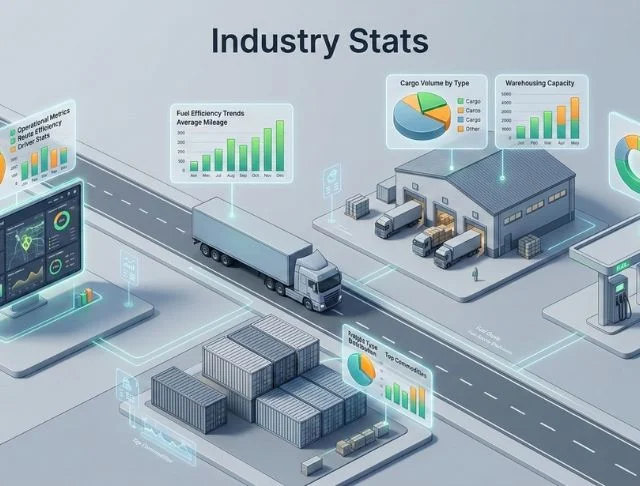
Tariffs not only create short-term volatility but also drive long-term changes in trucking networks. Supply chain adjustments, nearshoring, warehouse expansion, and technology adoption are reshaping the industry.
Nearshoring and Domestic Freight Growth
BTS data underscore that trend: in 2024, trucks carried 72.5% of U.S.–Mexico trade by value (vs 11.7% by rail). Similarly, 55.5% of U.S.–Canada trade was trucked (vs 13.8% by rail). These shares have crept upward.
For example, new factories in Mexico (auto plants, electronics) and US-Mexico assembly lines have produced thousands of extra weekly truckloads. More U.S. exports go by road as well.
Anecdotally, data show that U.S.–Mexico trucking volumes increased steadily in 2023–25 despite tariffs, reflecting integrated supply chains.
Supply Chain Diversification Impact on Regional Trucking
Inland distribution and cross-border flows instead of solely coastal. For example, retailers using Southeast Asia and South America have increased shipments through East/Gulf ports, boosting freight in Atlanta–Chicago–NYC corridors.
Technology firms diversifying away from one country have shifted some import volumes to new ports, spawning new truck routes. These changes are early and diffuse, but we see evidence: Colliers and CBRE report growing DC development in nontraditional hubs (Midwest, Sun Belt) in 2024–25.
Lanes between Mexico and the Southeast (e.g., Laredo–Houston) and between the Northeast and Western U.S. (via Land Bridge intermodal) are expanding.
Warehouse Expansion and Distribution Center Relocation Trends
Colliers reports net absorption of U.S. industrial space jumped to 60 million sq ft in Q3 2025 (up 20M YoY), driven by large DC projects. Several national retailers announced new mega-warehouses (e.g., Dollar Tree, Ahold Delhaize, New Balance) to hold higher inventory.
At the same time, new construction pipelines shrank to 270M sq ft (the lowest since 2018), signaling a pullback in overbuilding. This warehouse expansion has a direct trucking impact: more freight destined to distribution centers (not store-fronts) and increased cross-dock/short-haul truck trips.
Technology Adoption and Cost-Control Strategies
In brokerage and supply-chain management, digital freight matching and AI-driven forecasting are being used more to find freight faster and at lower cost. For example, AI-powered load boards can cut deadhead miles by 10–20%.
Insurance and compliance tech (e.g., mobile E-logs, blockchain for cargo traceability) are also on the rise to contain overhead. While precise metrics are limited, industry surveys show a clear uptick in investment in these technologies through 2024–25.
Source: SupplyChainDive
Conclusion
U.S. tariffs over the past several years have created a highly volatile environment for trucking, driving short-term spikes in freight rates and volumes while compressing long-term margins.
Data from 2023–2025 show that small carriers and owner-operators have been hardest hit, with rising equipment, fuel, and insurance costs eroding profits and prompting elevated bankruptcy rates.
Overall, tariffs have underscored the need for carriers to adopt strategic cost management, technology solutions, and flexible routing to sustain operations amid ongoing uncertainty.